
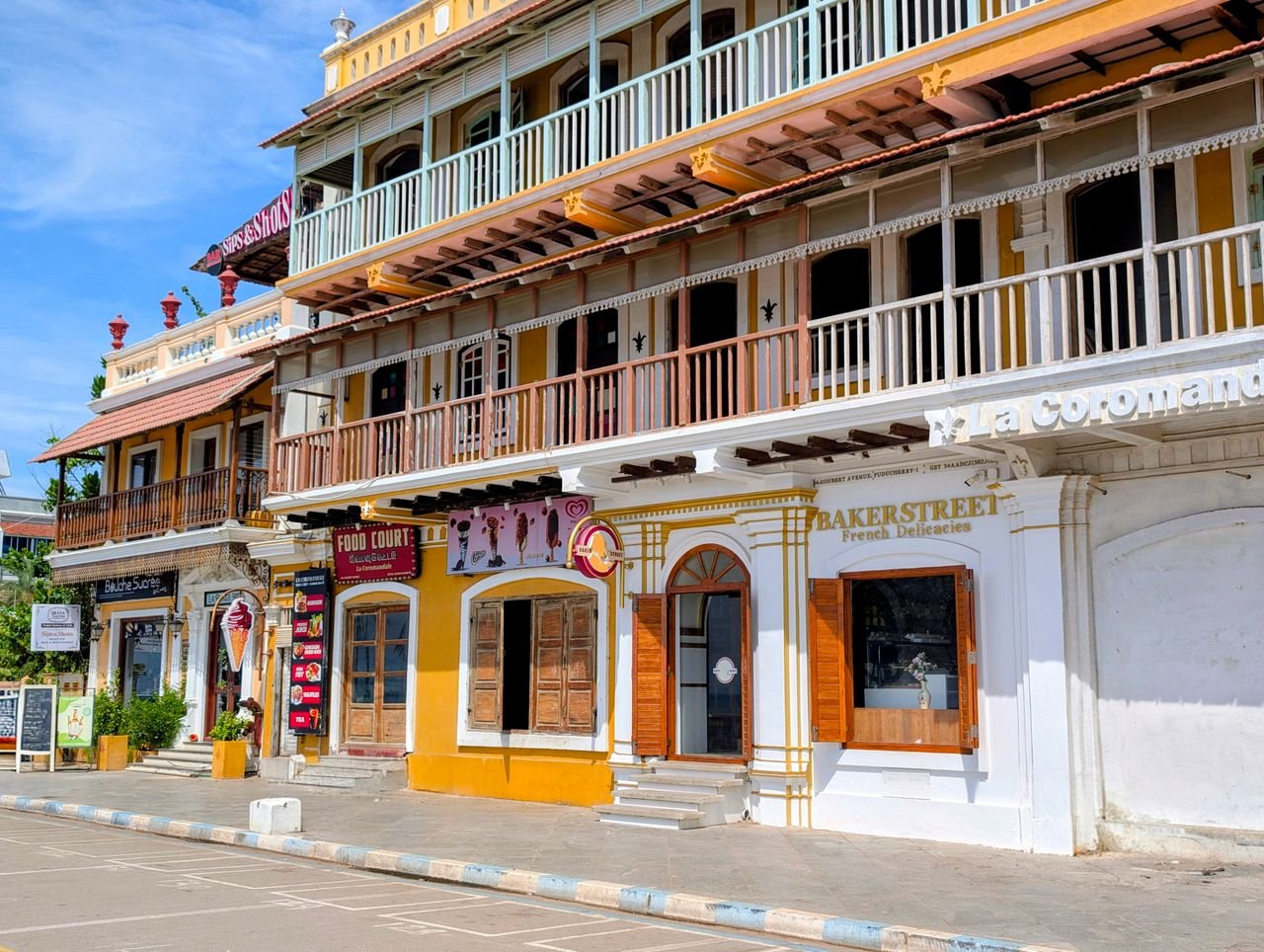
There is a strip of India’s eastern coastline where the street signs are still in French, the buildings are painted mustard yellow and white by heritage law, and the whole town smells faintly of fresh bread in the morning and the Bay of Bengal by evening. Pondicherry, officially Puducherry, spent close to three hundred years as a French colonial territory, and unlike almost every other former colonial holding in India, it never entirely let go of that inheritance. What is left is not a museum piece. It is a genuinely lived in, slightly surreal blend of Tamil Nadu and the French Riviera, a hundred and sixty kilometres and one very good coastal drive from Chennai.
Two towns divided by a canal
Pondicherry splits cleanly into two halves. White Town, or Ville Blanche, is the French Quarter, heritage buildings with bougainvillea spilling over compound walls, street names like Rue Romain Rolland surviving intact from the colonial period, and a strict local law preventing any high rise construction, which is the entire reason it still looks the way it does. Across a canal sits the Tamil Quarter, once dismissively called Ville Noire, a completely different register of Indian street life, temples, markets, and the kind of density White Town has legislated out of existence.
Most visitors spend their time almost entirely in White Town, and it is worth resisting that pull at least once. The two halves of the city were never meant to be separate experiences, and the contrast between them is a large part of what makes Pondicherry more interesting than a simple heritage stopover.
Promenade Beach, known locally as Rock Beach, runs a mile and a half along the town’s edge, protected by a line of large boulders rather than sand, making it more a walking and gathering space than a swimming one. Mornings bring joggers and yoga practitioners, evenings bring families and food stalls, and the stretch is closed to vehicles after dark, one of the few genuinely pedestrian friendly beachfronts in urban India.
Auroville, the experiment twelve kilometres out
No visit to Pondicherry is complete without at least a half day at Auroville, and understanding what it actually is changes the experience considerably. Founded in 1968 by Mirra Alfassa, known to her followers as the Mother, and designed by French architect Roger Anger, Auroville was conceived as a universal township where people from every nation could live beyond religion, politics, and nationality. It remains, more than fifty years later, one of the most ambitious intentional communities anywhere on earth, home to residents from dozens of countries practising organic farming, sustainable architecture, and communal living.
At its physical and symbolic centre sits the Matrimandir, a vast golden sphere that houses what is reportedly the largest optically perfect glass globe in the world, used for silent meditation. Viewing the inside requires advance booking, typically one to two days ahead through the Visitor’s Centre, and is worth the planning. Auroville is not a tourist attraction in the conventional sense, and treating it as one tends to produce a hollow visit. Start at the Visitor Centre, take in the exhibits and short documentary on the township’s founding philosophy, then walk or take the shuttle out toward Matrimandir with at least a little context for what you are looking at.
The Sri Aurobindo Ashram, back in town, is where the philosopher and spiritual teacher Sri Aurobindo settled in 1910 and where the Mother later joined him, together shaping much of the thinking that eventually produced Auroville. The ashram’s central courtyard holds the Samadhi of both figures, and the rules are strict and worth knowing before arrival, no photography, silence expected, simple dress, phones away.
What to eat, and where the French part actually shows up
Pondicherry’s food is the clearest evidence of its layered history, French patisserie sitting a few doors down from Tamil filter coffee stalls, both entirely at home. Rue de la Marine and the streets around it hold most of the town’s boutique cafes, Le Cafe runs 24 hours, Baker Street is the reliable stop for a genuinely good baguette, and Cafe des Arts and Zuka Chocolate round out a small but serious cafe culture rare anywhere else on this coastline. For dinner, the French Indian fusion restaurants scattered through White Town are where the town’s two identities show up most literally on the same plate.
Getting there and getting around
There is no significant airport in Pondicherry itself. Most travellers fly into Chennai, roughly 160 kilometres and a two and a half hour drive via the East Coast Road, one of the more scenic short drives in South India. Direct trains connect from Chennai in around three and a half hours, and overnight buses run from Bangalore for those coming from further afield.
Within the town, a rented scooter, around 400 rupees a day, is the way locals and long stay visitors get around, and the French Quarter in particular rewards being explored on two wheels rather than on foot alone, small enough to cover quickly, atmospheric enough to want to linger in every second street.
When to go
October through March brings the most comfortable weather, a pleasant 20 to 28 degrees, and is rightly considered peak season. April through June turns genuinely uncomfortable, low thirties with humidity that makes walking tours a chore. The monsoon months bring their own quieter reward, off season rates, greener surroundings, and a French Quarter that, by several accounts, looks even better wet, cobblestones shining, bougainvillea heavier, cafes fuller of people waiting out the rain with a coffee they were in no hurry to finish anyway.
Pondicherry never asks to be taken too seriously, and that may be its greatest strength. It is not attempting to out heritage Hampi or out spiritual Varanasi. It offers something smaller and quietly rarer, a genuinely walkable Indian town where two entirely different worlds have been sharing the same few streets for three hundred years, and have somehow, against most odds, gotten along.