
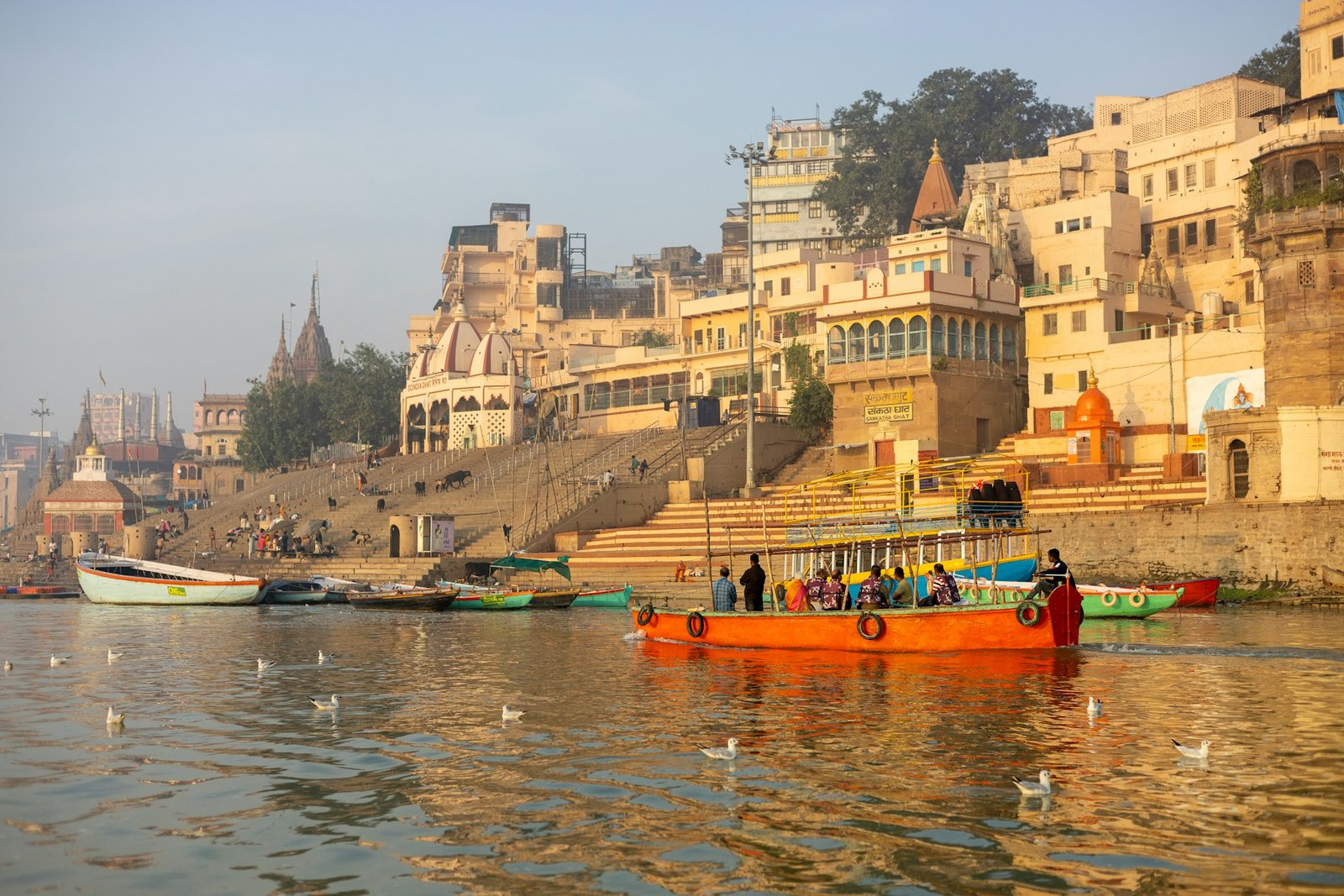
Mark Twain, visiting in the nineteenth century, wrote that Varanasi was older than history, older than tradition, older even than legend, and looked twice as old as all of them put together. He was not exaggerating for effect. Varanasi, also called Kashi or Banaras, is among the oldest continuously inhabited cities on earth, its riverside life stretching back more than three thousand years, older than Rome, older than Athens, still fully, chaotically alive today in exactly the way it was centuries ago.
Eighty eight steps into the sacred
The city’s identity is built quite literally into its riverfront. Eighty eight ghats, stepped stone embankments, line four kilometres of the western bank of the Ganga, most constructed or renovated by Maratha and Rajput rulers in the eighteenth century, some still privately owned by old royal families, others managed by trusts and the municipal corporation. Walking the full stretch from Assi Ghat in the south to Raj Ghat in the north takes two to three hours at an unhurried pace, though almost everyone chooses to do at least part of it by boat instead, at the one time of day the ghats look their best.
Dashashwamedh Ghat is the one every visitor eventually reaches, the busiest and most photographed stretch of riverfront in the city. Its name translates to the ghat of ten sacrificed horses, tied to a legend of Lord Brahma performing a great ritual here to recall Shiva from exile. Every single evening, without exception in living memory, seven young priests perform the Ganga Aarti here, a synchronised fire ceremony with multi tiered brass lamps, conch shells, and Sanskrit chanting, offered not as performance for the crowd but as devotion directed at the river herself. The priests face the water throughout, not the audience, a detail that changes how the whole ceremony reads once you notice it.
Manikarnika and Harishchandra Ghats operate on an entirely different register. These are the city’s cremation ghats, working continuously, day and night, believed by Hindus to grant moksha, liberation from the cycle of rebirth, to those cremated on their steps. This is not staged for visitors and should never be treated as spectacle. It is, quite literally, the place where Varanasi stops being a tourist destination and becomes something considerably more serious, a live encounter with how this city understands death.
Assi Ghat, at the opposite end of the emotional spectrum, is the gentlest entry point, the hub for students, foreign travellers, and morning yoga sessions, home to a smaller, more intimate version of the evening aarti and a genuinely lovely dawn scene of sun salutations, flower vendors, and boats sliding quietly into golden mist.
The boat ride nobody should skip
The single most recommended experience in Varanasi is a dawn boat ride, ideally between five thirty and seven in the morning, departing from or near Assi Ghat. The reason it works so well is architectural rather than spiritual, the eastern bank of the Ganga opposite the city has no buildings, only open farmland stretching to the horizon, and Varanasi itself faces east. As the sun rises over that empty land, the entire western bank of temples and ghats lights up in sequence, gold, then white, then fully lit, a sight pilgrims have watched from the water for well over a thousand years.
Negotiate the boat fare before stepping in, not after. A shared boat runs roughly 200 to 400 rupees per person in 2026, a private one 500 to 800. If a boatman tries to renegotiate mid river, and it does happen, the price agreed to on the ghat is the price that holds.
Beyond the river
Kashi Vishwanath Temple, one of the twelve Jyotirlingas most sacred to Shiva devotees, sits close to the ghats and draws enormous daily footfall. Sarnath, a short distance outside the city, marks the place where the Buddha delivered his first sermon after enlightenment, a serene counterpoint to the intensity of the river front, essential for anyone interested in Buddhist history. Banaras Hindu University’s sprawling campus, home to the Bharat Kala Bhavan museum and the New Vishwanath Temple, adds a quieter, more contemplative stop to a Varanasi itinerary that can otherwise feel relentless.
When to go
Winter, November through February, is the accepted best window, cool enough for long hours of walking and boat rides without the punishing humidity of the rest of the year. Dev Deepawali, celebrated fifteen days after Diwali, is worth building a trip around specifically, when thousands of oil lamps are lit along every ghat simultaneously, transforming the entire riverfront into what is arguably India’s most beautiful single night of the year.
What nobody quite prepares you for
Varanasi is not a comfortable city in the conventional travel sense, and it does not try to be. The lanes are narrow, the crowds constant, the presence of death and devotion woven into daily life in a way that can be genuinely disorienting for a first time visitor. But this is also precisely why people return to it decade after decade. Few places on earth let you watch an unbroken three thousand year old ritual performed at the exact hour it has always been performed, on a river that a huge portion of humanity considers the holiest water on the planet. Varanasi does not perform spirituality for visitors. It simply continues being what it has always been, and allows you to watch.