
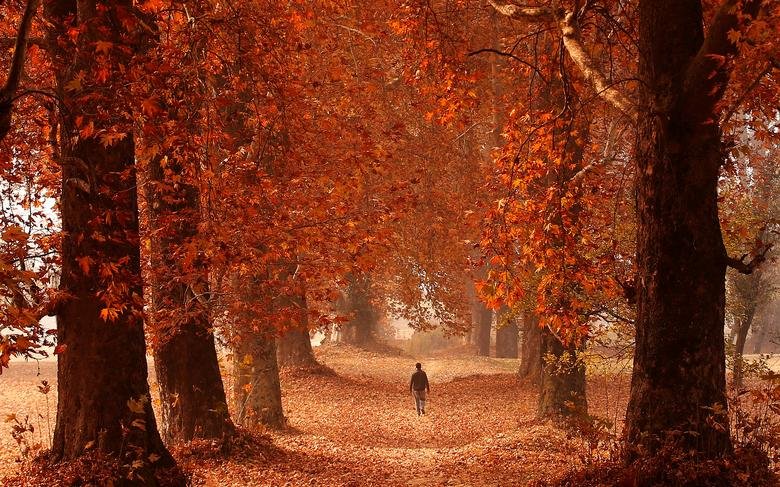
Kashmir has a marketing problem that works against the people who would enjoy it most. The valley sells itself on two images, the snow of December and January and the meadows of May and June, and between them they absorb almost all the traffic the region gets. Both are real. Both are also the most expensive and most crowded versions of the place.
The version locals will tell you about, if you ask, is the one in between. Autumn in Kashmir has its own name, Harud, and it is not simply the shoulder season between two better ones. It is the season the valley is most itself.
What actually happens
The chinar is a plane tree, some of them several centuries old, and it is the closest thing Kashmir has to a national emblem. Through summer the leaves are a heavy, unremarkable green. Then, over a period of about three weeks, they run through gold, orange, copper and a deep blood red before dropping. The change is not gradual in the way autumn is elsewhere. It arrives, holds, and goes.
The timing moves year to year with the weather, but the pattern is consistent. The first leaves begin turning in the last days of September, most trees are in full colour through the middle and second half of October, and by mid November a good share of them are bare. Early October is a mixed picture, some green and some turning. Late October is the picture people travel for.
Two other things happen in the same window. The apple harvest finishes across the orchards of Sopore and Shopian, which is the reason you will spend the month behind trucks stacked with wooden crates. And in Pampore, about fifteen kilometres from Srinagar, the saffron fields come into bloom. It is a purple crocus that flowers once a year, from late October into November, picked by hand at dawn before the sun opens the flower fully. It is the only time of year you can see it.
Where the chinars actually are
The Mughal gardens are the obvious answer and they are the correct one, but not all of them equally.
Nishat Bagh has the terraces and the Zabarwan range directly behind it, which means the colour has something to sit against. Shalimar Bagh has the older, larger trees and the better avenues. Both get busy on October weekends. Not summer busy, but busy.
Naseem Bagh, on the Kashmir University campus at the north end of Dal Lake, is the one most visitors miss entirely. It was planted with chinars under Akbar and holds one of the largest concentrations of mature trees in the valley. It is quiet on a weekday morning in a way Nishat is not.
Dachigam National Park, twenty odd kilometres out, is where the colour comes with wildlife attached. It is the last significant habitat of the hangul, the Kashmir stag. Entry requires permission from the wildlife department. Arrange it before you drive out, not at the gate.
The practical differences from summer
Rates. Houseboats and hotels in Srinagar sit well below their June and December numbers through October. The same applies to the Gulmarg and Pahalgam properties, with the exception of the last week of the month when domestic autumn travel traffic picks up around long weekends.
Temperature. Days run roughly 15 to 25°C in Srinagar in early October and drop steadily. Nights are between 5 and 10°C and colder by month end. Gulmarg and Sonamarg, both considerably higher, can see the first light snow from late October, which is worth knowing in both directions. It is beautiful and it can close a road.
Light. This is the part that matters and nobody mentions. Autumn light in the valley is low and long for most of the day, which means the hour either side of sunrise problem that governs photography in most of India does not apply here in the same way. October in Srinagar is forgiving in a way June is not.
What to do differently
Take the shikara in the morning, not at sunset. The sunset ride on Dal Lake is the one every package includes and it is when every boat is out. At seven in the morning the lake has mist on it, the floating vegetable market at the far end is actually operating, and there are perhaps a tenth as many boats.
Stay on a houseboat for one or two nights, not the whole trip. They are genuinely worth doing and they are also cold at night in late October, with heating that varies enormously between operators. Split the stay. A couple of nights on the water, the rest in a hotel or a homestay on land.
Drive to Pahalgam rather than Gulmarg if you have to choose. Gulmarg in October is between seasons. The meadows are past and the snow has not settled, and the gondola is the main draw. The Lidder valley around Pahalgam holds its colour and its walking longer.
Go to Pampore at dawn, not midday. The saffron flowers are picked in the early morning and the fields are emptied by late morning. Arriving at two in the afternoon means looking at a purple field with nobody in it, which is a different and lesser photograph.
The thing to plan around
Autumn is short. The distinguishing feature of Harud, compared to autumn almost anywhere else, is how compressed it is. It is a matter of three or four weeks between the first turn and the drop, and the exact dates shift with the year’s weather. Nobody can tell you in July which week of October will be at peak.
What that means practically is that this is not a trip to book eight months ahead against a fixed itinerary. It is a trip to book four to six weeks out, when the season is close enough to read, and to keep flexible by a few days at either end. The upside of the shoulder season is that this is possible. In October, unlike June or December, the rooms are still there.