
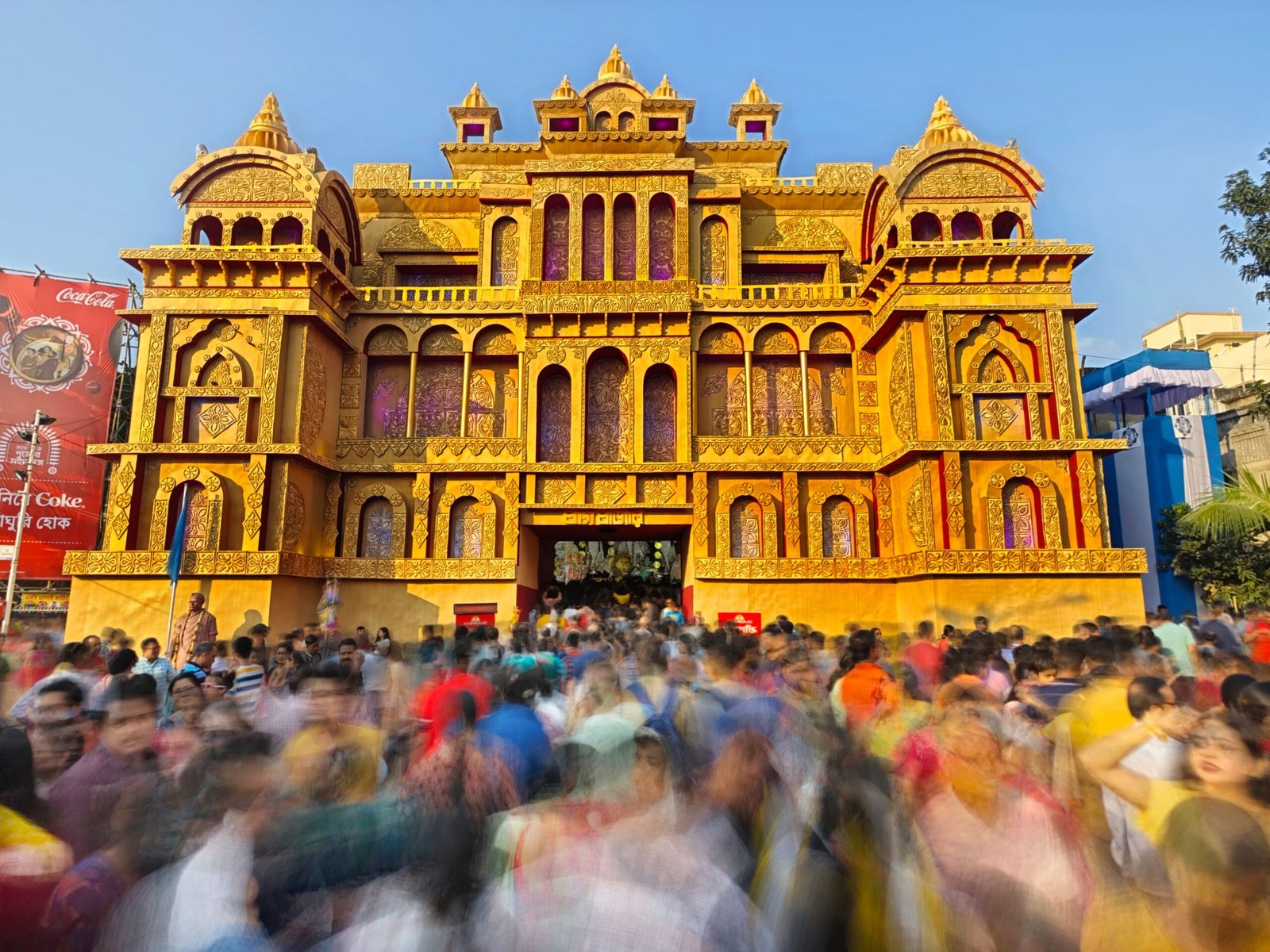
Most cities have a festival. Kolkata has a festival that temporarily rearranges the city, its traffic, its economy, its sleeping hours and several hundred of its street corners, and then dismantles the whole thing and throws it in the river.
That is not a metaphor. The pandals of Durga Puja are full scale temporary structures, some of them several storeys high, built by professional artisans over weeks, occupied for five days, and taken down. UNESCO inscribed Durga Puja in Kolkata on its list of intangible cultural heritage in 2021, and the citation covered not just the worship but the entire apparatus around it: the idol makers, the pandal designers, the drummers, the lighting crews, the communities that fund it.
It is the largest public art event in India and almost nobody outside eastern India travels for it.
The dates, and a note on why they wobble
In 2026, Mahalaya, the dawn that opens Devi Paksha and the fortnight of the goddess, falls on Saturday 10 October. The five main days run from Shashthi to Vijaya Dashami in the week of 16 to 21 October.
You will see slightly different dates across sources, and this is not carelessness. Lunar tithis do not align neatly with sunrise to sunrise days, so some panchangs place Shashthi on the 16th and others on the 17th, which shifts Dashami correspondingly. The three days that are consistent across almanacs are Ashtami, Navami and Dashami, and those are the three that matter most for a visitor. Confirm against a Kolkata panjika before you fix flights, and build in a day either side.
What each day actually is
Mahalaya is not part of the puja proper. It is the day the countdown starts, marked before dawn by a radio broadcast that has been running for generations, and in Kumartuli by the painting of the idols’ eyes, the ritual that is understood to bring the image to life.
Shashthi is the arrival. The goddess is welcomed at dusk and the pandals open. The crowds are still manageable.
Saptami and Ashtami are when the city stops pretending it is going to work. Ashtami is the most significant day. Sandhi Puja, performed at the exact junction between Ashtami and Navami, runs for forty eight minutes and is timed to the minute. Every pandal announces its own window.
Navami is the last full day and, by common agreement, the most relaxed. The obligation is over, the immersion has not started, and the city eats.
Dashami is the immersion, and the goodbye. Sindoor khela in the morning, the idols carried to the river through the afternoon and night.
How to do it without wasting the trip
Do not attempt north and south in one night. Kolkata’s pujas divide broadly into two traditions: the older, more classical grandeur of north Kolkata’s household and neighbourhood pujas, and the theme driven contemporary art of the big south Kolkata pandals. They are genuinely different experiences and they are also an hour apart in Puja traffic, which is a category of traffic unlike any other. Give each a night.
Walk. There is no other option. Large sections of central and north Kolkata are closed to vehicles during the peak nights. The metro runs extended hours specifically for this. Anyone planning to move by car between pandals on Ashtami night has misunderstood the situation.
Go at odd hours. The serious pandal hoppers start at eleven at night and finish at four in the morning, and they are right. The queues at the famous pandals in the evening run to hours. At two in the morning the same pandal is walkable, lit, and staffed by people who are pleased you came.
Visit Kumartuli before the puja, not during. The idol makers’ quarter in north Kolkata is where the images are built, from Ganges clay on straw and bamboo frames. In the fortnight before Puja it is a working district of several hundred studios with idols in every state of completion. By Shashthi they have all gone out to the pandals and there is nothing to see.
Eat at the pandals. The food stalls outside the community pujas are not an afterthought. For a large part of the city they are the point. Khichuri and beguni, kathi rolls, and the sweet shops running at capacity.
The part that catches people out
Hotels. Kolkata’s hotel stock sells out for Puja week further ahead and climbs harder than for almost any other Indian festival, because the demand is not only tourists. It is the enormous returning diaspora of Bengalis who come home for these five days specifically. If you are reading this in September for an October trip, book accommodation before you book anything else.
Stay central. Park Street, Esplanade, or along the AJC Bose Road corridor puts both halves of the city within reach and, more importantly, within walking distance of a metro station that will still be running at one in the morning.
If you cannot get to Kolkata
The Puja is not a Kolkata monopoly, though Kolkata is its most extreme expression. Bengali communities across India stage substantial pujas, including Delhi’s CR Park, Mumbai’s Shivaji Park and Bangalore’s several, and they are worth an evening. But they are a different scale of thing, and anyone who has seen Kolkata during those five days will tell you so, at length, and probably unprompted.