
The founder of the Mughal empire was born in a valley in eastern Uzbekistan. Babur left Fergana as a teenager, spent years trying and failing to hold Samarkand, and eventually turned south towards India instead. Most Indians know the empire he built. Very few have seen the country he came from.
Uzbekistan sits at the centre of the old Silk Road, and its three great cities, Samarkand, Bukhara and Khiva, hold some of the most extraordinary Islamic architecture anywhere in the world. Tiled domes in a blue that does not look real. Madrasas the size of city blocks. Streets that traded in silk, spice and paper for a thousand years before Europe knew what any of it was worth. And almost none of it appears on Indian travel itineraries.
Samarkand
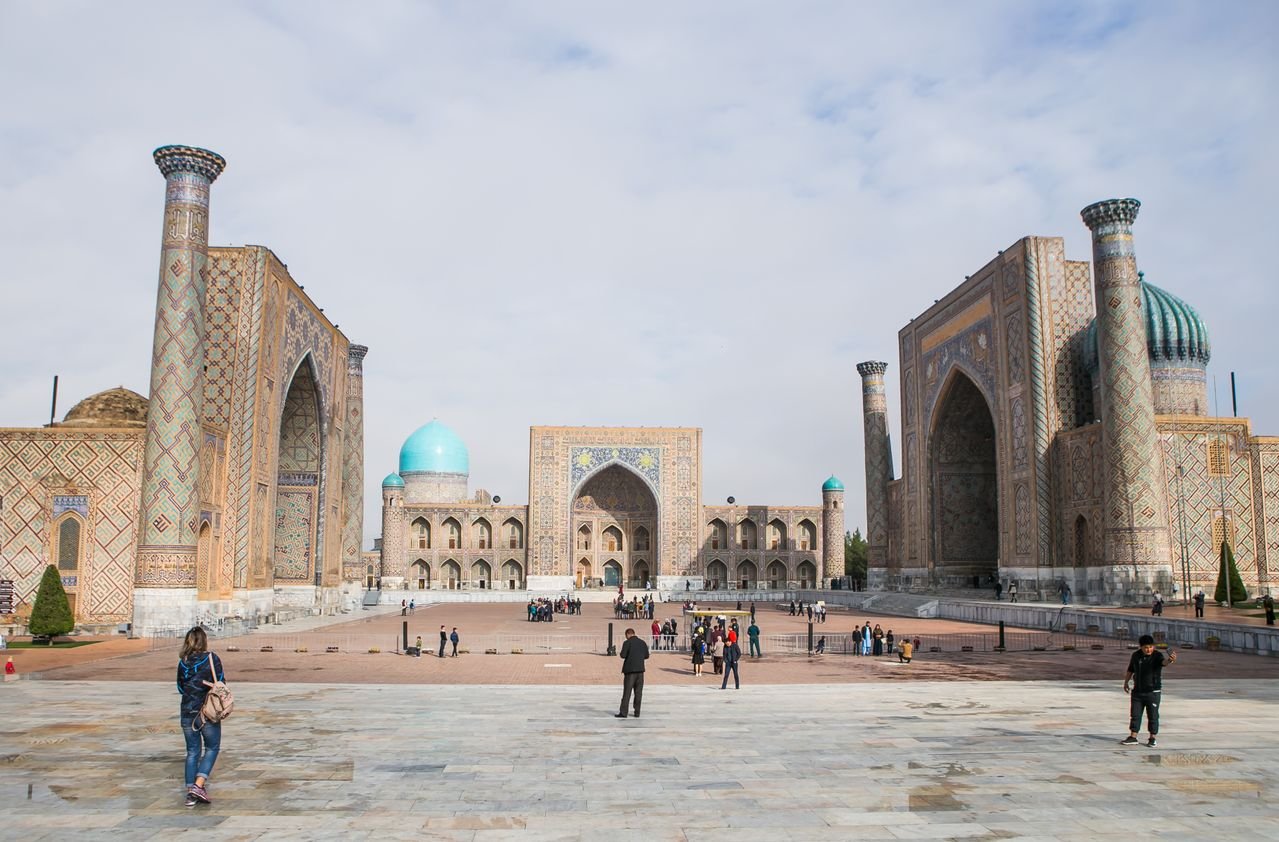
The Registan is the image most people eventually see of Uzbekistan without knowing where it is. Three madrasas facing a single square, each one covered floor to dome in blue and gold tilework, built across two centuries and somehow arranged as though planned in a single afternoon. Stand in the middle of it at dusk, when the crowds thin and the light goes warm, and the scale of it takes a while to process.
A short walk away is Gur-e-Amir, the tomb of Timur, who Indians know as Tamerlane and who Babur claimed descent from. The Shah-i-Zinda necropolis, a narrow avenue of tombs climbing a hillside, is quieter and, for many visitors, the more affecting of the two.
Bukhara
If Samarkand is monumental, Bukhara is lived in. The old city is compact enough to walk end to end, and its centre still gathers around Lyabi-Hauz, a stone pool shaded by mulberry trees where the town has been sitting and drinking tea for four hundred years. The Kalyan Minaret, forty six metres of eleventh century brickwork, was reportedly spared by Genghis Khan when he destroyed almost everything else around it.
Khiva
Khiva is the smallest of the three and the most complete. Itchan Kala, the walled inner town, is effectively a preserved medieval city that people still live inside. It takes half a day to walk properly and it is worth staying a night, because Khiva after dark, with the walls lit and the day visitors gone, is a different place entirely.
Getting there and getting around
Tashkent is roughly a three and a half hour flight from Delhi. Uzbekistan offers an electronic visa to Indian passport holders, applied for online with a modest fee, and processing is usually quick. Rules do change, so confirm the current position before booking.
Once inside the country, the Afrosiyob high speed train connects Tashkent, Samarkand and Bukhara comfortably and cheaply, and booking a few days ahead is enough in most seasons. Khiva is further west and either a long train or a short domestic flight.
What nobody tells you
The food will feel more familiar than you expect. Plov, the national rice dish, is a close cousin of pulao. Samsa are baked, not fried, but the resemblance to samosa is not a coincidence. Lagman noodles, non bread stamped in patterns and pulled from a tandyr, kebabs cooked over coals. Indian travellers tend to eat very well here.
Best months are April to early June and September to October. Summers cross forty degrees in the desert cities and winters are genuinely cold. And carry cash in small denominations; card acceptance improves every year but is still uneven outside Tashkent.