
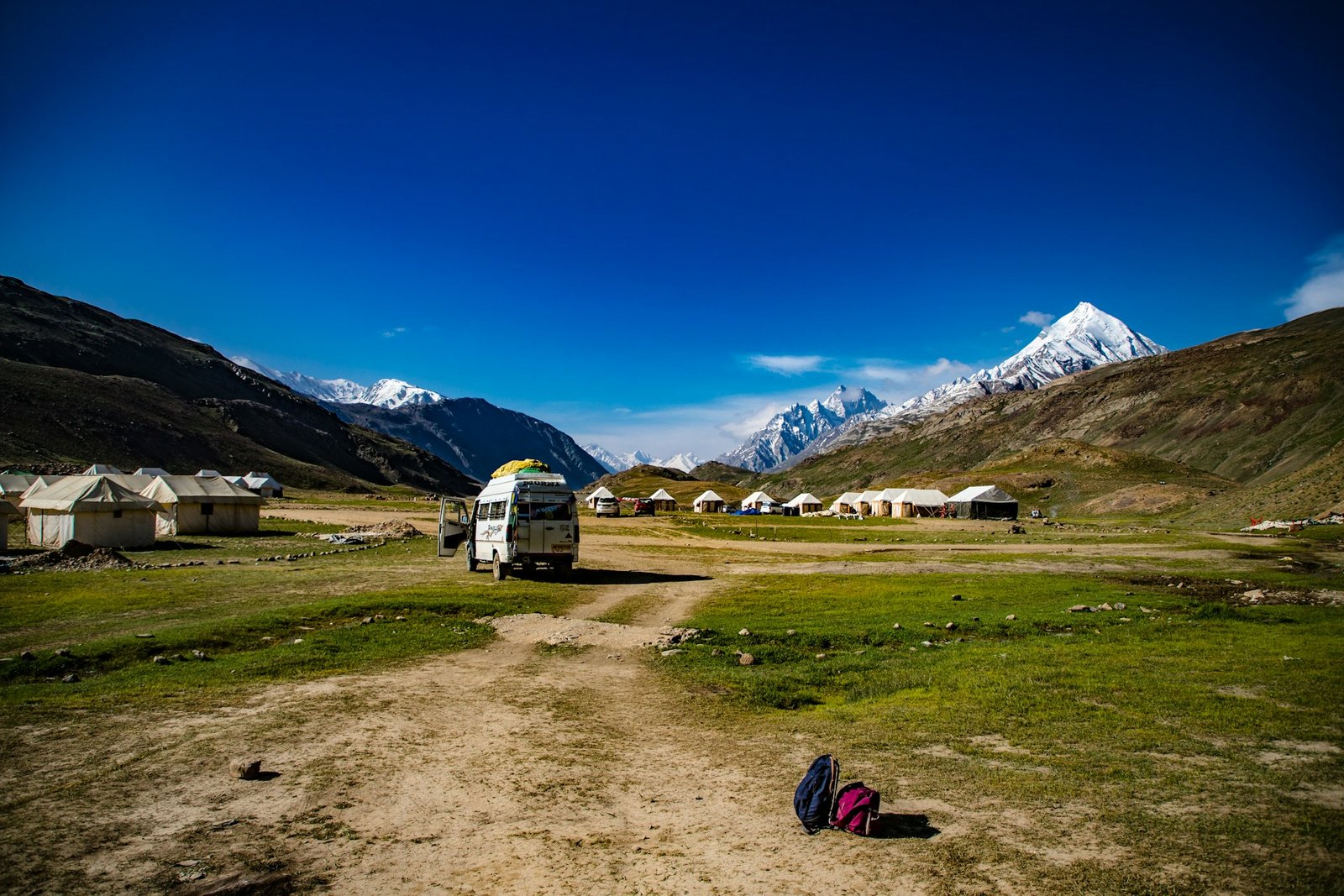
There are places in India that surprise you with green, and there are places that surprise you by refusing it entirely. Spiti Valley belongs to the second kind. Tucked into the trans Himalayan belt of Himachal Pradesh, at an average height of nearly thirteen thousand feet, Spiti is a cold desert, a landscape of bare brown mountains, thin blue rivers, and monasteries that have watched the same silence for a thousand years. The name itself means the middle land, because that is what it is, a strip of terrain caught between India and Tibet, belonging fully to neither, shaped by both.
Most people who go looking for the Himalayas expect pine forests and waterfalls. Spiti gives them something closer to the moon. Rounded, wind carved mountains in shades of ochre and grey. A sky so clean it looks unreal in photographs. Villages of a few hundred people who have farmed barley and peas on impossibly thin terraces for centuries, under a Buddhist calendar that has not changed much either.
A cold desert with its own weather rules
Spiti sits in a rain shadow, which is the reason it looks the way it does and the reason it can be visited even when the rest of the Himalayas are drowning. While Kinnaur and Manali take the brunt of the monsoon, Spiti itself receives very little rain, its narrow valleys too far behind the mountain wall for the clouds to reach. The approach roads are a different story. The Shimla Kinnaur route and the Manali side both pass through zones that do get monsoon rain, and landslides on those stretches are common between July and September. The valley floor stays dry. The road to it does not always cooperate.
This makes Spiti an odd, useful piece of knowledge for a certain kind of traveller, the one looking at a monsoon soaked calendar in June and wondering where in the mountains still has blue sky. The honest answer is May and June, before the access roads see their worst landslide activity, or September, just after, when the light turns gold and the crowds thin out.
The monasteries that hold the valley together
Key Monastery is the one every photograph of Spiti eventually leads back to, a thousand year old Tibetan Buddhist complex stacked up a conical hill above the Spiti river, its whitewashed walls catching the last light of the day in a way that has made it one of the most photographed monasteries in the Indian Himalayas. Inside, the corridors are dim and narrow, lined with old thangka paintings and the low murmur of monks at prayer.
Tabo, further down the valley, is quieter and in some ways more remarkable. Founded in 996 AD, it is often called the Ajanta of the Himalayas for its mud walled halls covered in murals that have survived over a thousand years of cold desert winters. Rudyard Kipling wrote of this region as a place where the gods live, and standing inside Tabo’s dim, incense heavy chambers, it is not a hard sentence to believe.
Villages that hold world records nobody is fighting over
Hikkim, a short drive from the district town of Kaza, has the highest post office in the world still in operation, a small room where a postmaster stamps postcards by hand for travellers determined to send a letter from above 14,000 feet. Komic, nearby, claims the title of the highest motorable village on earth. Langza announces itself with a giant seated Buddha statue overlooking the valley, and the ground around the village is so fossil rich that finding a small ammonite in the dirt is less a treasure hunt than an expectation.
None of these places are trying to impress you with infrastructure. A homestay in Kibber or Langza usually means a simple room, a shared bathroom, and a family who will feed you more food than you can finish. That is the trade Spiti asks of its visitors, comfort for something considerably rarer.
The practical shape of a Spiti trip
Getting in is part of the experience whether you like it or not. From Manali, the route crosses the Rohtang and Kunzum passes, a dramatic but technically involved drive of under two hundred kilometres that can still take the better part of a day. From Shimla, the route via Kinnaur is longer, over four hundred kilometres, but gentler on the body and considered safer for those worried about altitude sickness, since it gains height more gradually.
There is no airport in Spiti and no plan to build one soon. The nearest is Bhuntar near Kullu, still a full day’s drive from Kaza. This is not an oversight. It is the entire point. Spiti has stayed the way it is partly because reaching it has never been convenient.
Altitude is worth taking seriously here, more seriously than most first time visitors expect. Kaza itself sits above 12,000 feet, and symptoms of acute mountain sickness, headache, nausea, breathlessness, are common enough that most operators build in a rest day before pushing further up the valley. Diamox is widely carried by travellers as a precaution, though it is worth discussing with a doctor before the trip rather than after the headache starts.
The lake that gives the whole valley its final image
Chandratal, the moon lake, sits at over 14,000 feet near the Kunzum pass, a crescent of impossibly blue water ringed by scree slopes and silence. Most visitors see it as a day trip, though camping on its shore under a sky with almost no light pollution is the version people tend to remember years later. The water is glacial, the wind constant, and the whole scene looks like it was built for exactly one photograph, the kind you take once and never quite manage to explain properly to anyone who was not there.
Spiti does not compete with the rest of the Himalayas on drama the way Ladakh does, or on green the way Himachal’s other valleys do. It offers something quieter and, in its own cold, dry way, more complete. A landscape stripped down to rock, light, and the sound of prayer flags in wind, and villages that have made peace with all three centuries ago.