
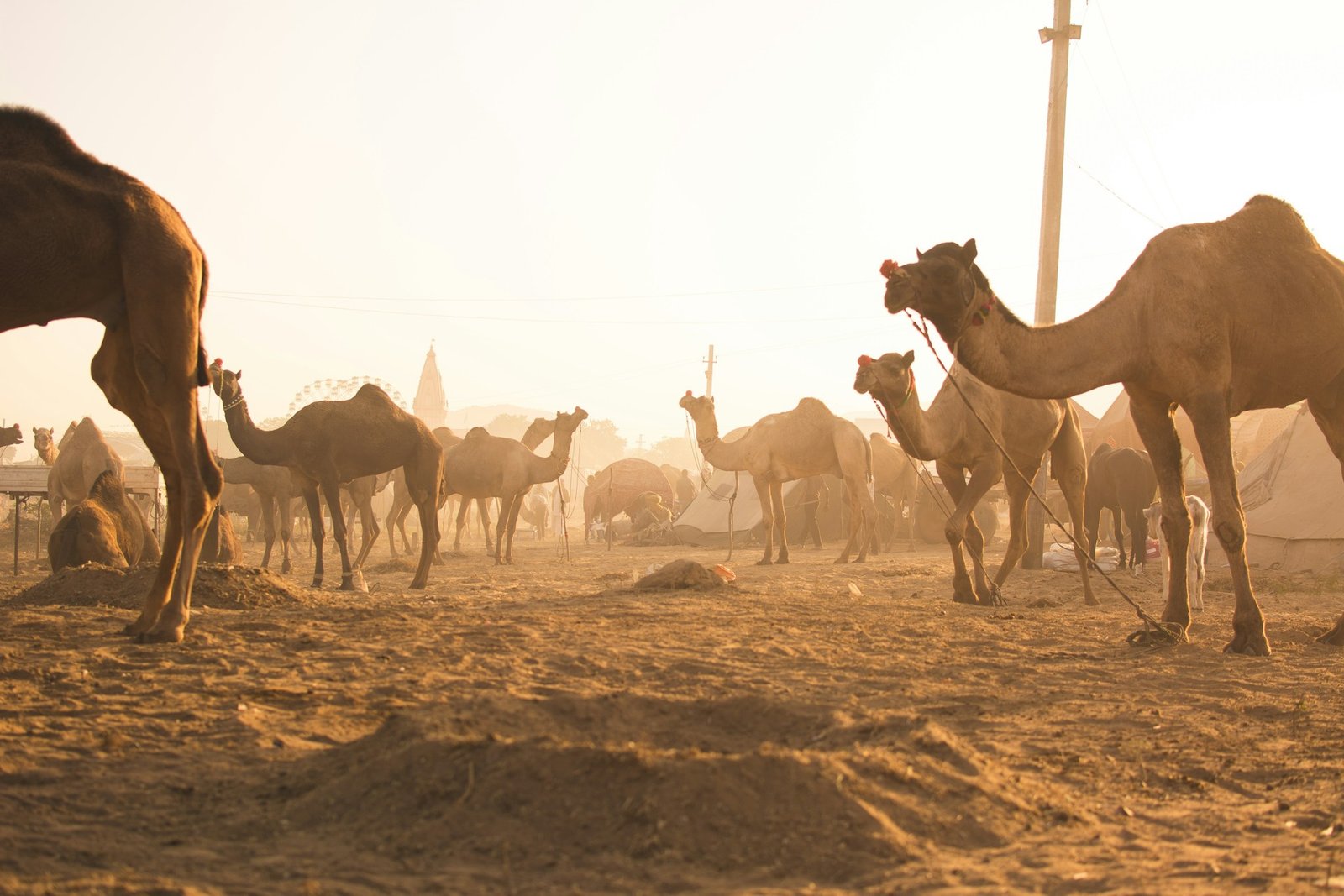
Pushkar is a town of roughly 20,000 people for most of the year. For one week every November, more than 50,000 camels, horses, and cattle arrive with their traders, along with several hundred thousand pilgrims, and the town’s entire population effectively turns inside out. It is not a festival built for tourists. It is a centuries old livestock trading fair and a Hindu pilgrimage that happen to overlap on the calendar, and the overlap is the whole point.
The two events are older than each other’s memory of when they merged. The livestock fair is pure commerce, herders from across Rajasthan travelling for days across the desert to buy, sell, and show camels, horses, and cattle, alongside competitions that have nothing to do with religion at all, camel races, tug of war, and the fair’s most photographed event, the longest moustache and best turban contests. The trading peaks in the fair’s first days, when the fairground fills with animals decorated in bells, beads, and dyed wool, before the crowd’s energy shifts entirely toward the lake.
That shift happens on Kartik Purnima, the full moon of the Hindu month of Kartik, when Pushkar becomes one of the most important pilgrimage sites in the country for a single night and morning. Pushkar Lake is said to have formed when Lord Brahma dropped a lotus petal during a yagna, and the town holds one of the very few temples in the world dedicated to Brahma, the creator deity in the Hindu trinity, a genuine rarity given how few Brahma temples exist anywhere. On Kartik Purnima, upward of 200,000 pilgrims bathe in the lake at dawn, believing the water on this specific morning washes away a lifetime’s accumulation of karma. The 52 ghats ringing the lake fill with lit oil lamps and chanting before sunrise, and it is, by a wide margin, the most photographed single morning on the Rajasthan festival calendar.
In 2026, the fair runs from approximately 17 to 24 November, with the main livestock trading concentrated in the first four to five days and Kartik Purnima falling on Tuesday 24 November. Anyone travelling specifically for the trading and the desert carnival atmosphere should aim for the earlier days. Anyone travelling for Kartik Purnima itself should arrive a day or two before the full moon, since accommodation in the town fills fast and the ghats are at their most crowded, and most moving, on the night and morning of the peak itself.
Pushkar sits about 140 kilometres from Jaipur, roughly a three hour drive, and most visitors fly into Jaipur airport and continue by road. Accommodation ranges from basic guesthouses in town to tented desert camps on the fairground’s edge, and during fair week, booking months ahead isn’t excessive caution, it’s necessary. Beyond the fair and the lake, the town’s markets fill with silver jewellery, camel leather goods, and textiles, and street stalls sell kachori, malpua, and other Rajasthani specialties that are worth the trip on their own, quite apart from the camels.