
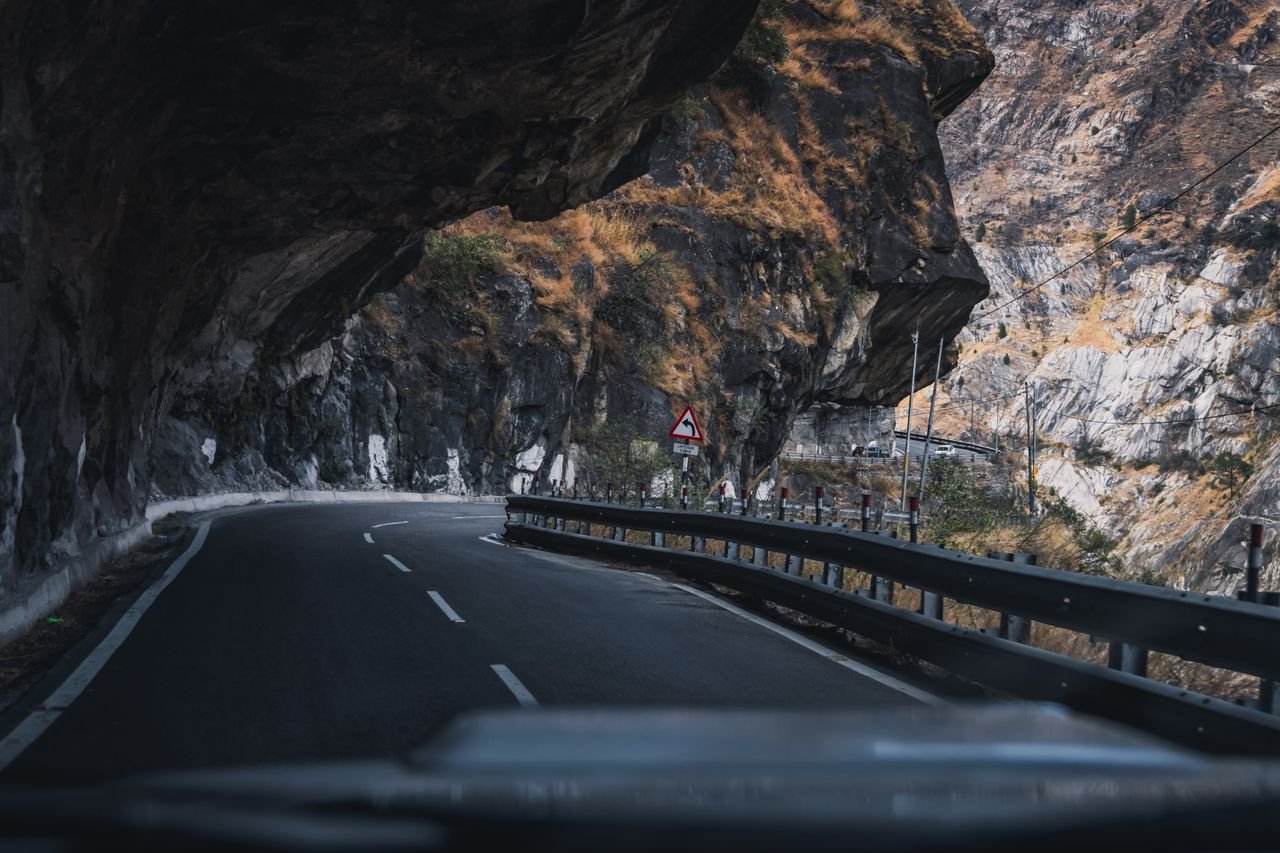
There is a kind of India you only meet from behind a windscreen. The train shows you the country through a window that never stops moving. The plane skips over it entirely. But the open road hands you the controls, lets you stop where you want, eat where the smell pulls you in, and watch the landscape change mile by mile. India rewards the road tripper like few countries on earth, from Himalayan passes scraping the sky to coastal highways hugging the Arabian Sea. Here are five drives worth clearing your calendar for.
Manali to Leh: the one every driver dreams of
If there is a single iconic Indian road trip, this is it. The Manali to Leh highway climbs through the high Himalayas over roughly two to three days, and the landscape transforms completely with every stage, from the pine-covered valleys around Manali to the stark, lunar emptiness of Ladakh. Along the way you cross some of the highest motorable passes in the world, tackle the famous Gata Loops with their twenty-one hairpin bends, and pass serene high-altitude lakes and Buddhist monasteries clinging to the hills.
This is a drive that demands respect. The altitude is real, and you must acclimatise gradually to avoid mountain sickness. The passes are only open roughly between late spring and early autumn, with the sweet spot generally from June to September once the snow has cleared. Take an SUV with good ground clearance, download offline maps, and never rush the ascent.
Mumbai to Goa: the coastal classic
Trading the intensity of Mumbai for the laid-back beaches of Goa is a rite of passage. There are two routes. The NH48 is faster with better roads. But the one to choose is the NH66, formerly the NH17, which runs closer to the coast through the lush Konkan belt. Along the way you pass sleepy fishing villages, Portuguese-era forts, and beach after quiet beach, with the air turning steadily saltier and the seafood steadily fresher. The full run covers around 590 kilometres and is best done over two to three days, ideally between October and February. This is the drive that inspired a generation of Indian road-trip films, and it still delivers.
Manali to Spiti: for the raw and the rugged
Where Manali to Leh is the famous one, the Spiti circuit is for travellers chasing something wilder and quieter. Running from Manali over the Rohtang and Kunzum passes into the Spiti Valley, this route of around 450 kilometres takes you through steep gorges, remote villages and a trans-Himalayan landscape that feels almost lunar. The rewards are ancient monasteries like Key and Tabo, the turquoise waters of Chandratal lake, and a culture shaped by centuries of Buddhist life. The window is short, roughly June to October, and the roads are demanding. That is exactly why those who drive it never forget it.
Chennai to Pondicherry: the short and romantic one
Not every great drive needs mountains. The East Coast Road from Chennai to Pondicherry runs just 150 kilometres or so along the Bay of Bengal, an easy one to two day escape on smooth coastal highway. Begin at Chennai’s Marina Beach, pass through fishing villages, stop at the UNESCO-listed Shore Temple at Mahabalipuram, and arrive in Pondicherry’s French quarter with its yellow-and-white colonial streets and its unhurried cafe culture. Best driven between November and February, it is the perfect introduction to road tripping for those not ready for the Himalayas.
Kolkata to Darjeeling: plains to tea country
For a drive that tells a story of transformation, few beat the roughly 600-kilometre run from Kolkata to Darjeeling. It begins in the riverside plains of West Bengal, passes through small Bengali towns, and slowly climbs into the misty foothills of the Himalayas and the tea gardens that made the region famous. Along the way lie Tagore’s Shantiniketan and hill stations where steam trains still puff through the clouds. Drive it between October and March, and give yourself time, because this is a journey to be savoured rather than rushed.
Before you turn the key
Whichever drive you choose, the essentials are the same. Carry your licence, registration and insurance. Pack a first-aid kit, a power bank and a basic toolkit. Download offline maps, because coverage vanishes in the remote stretches. Book stays in advance during peak season. And above all, build in time to stop, because on an Indian road trip the detours are very often the destination.
Our members get the full route breakdowns, the stops worth making, and the stays worth booking, drive by drive. The best of India by road, with TravelNode.