
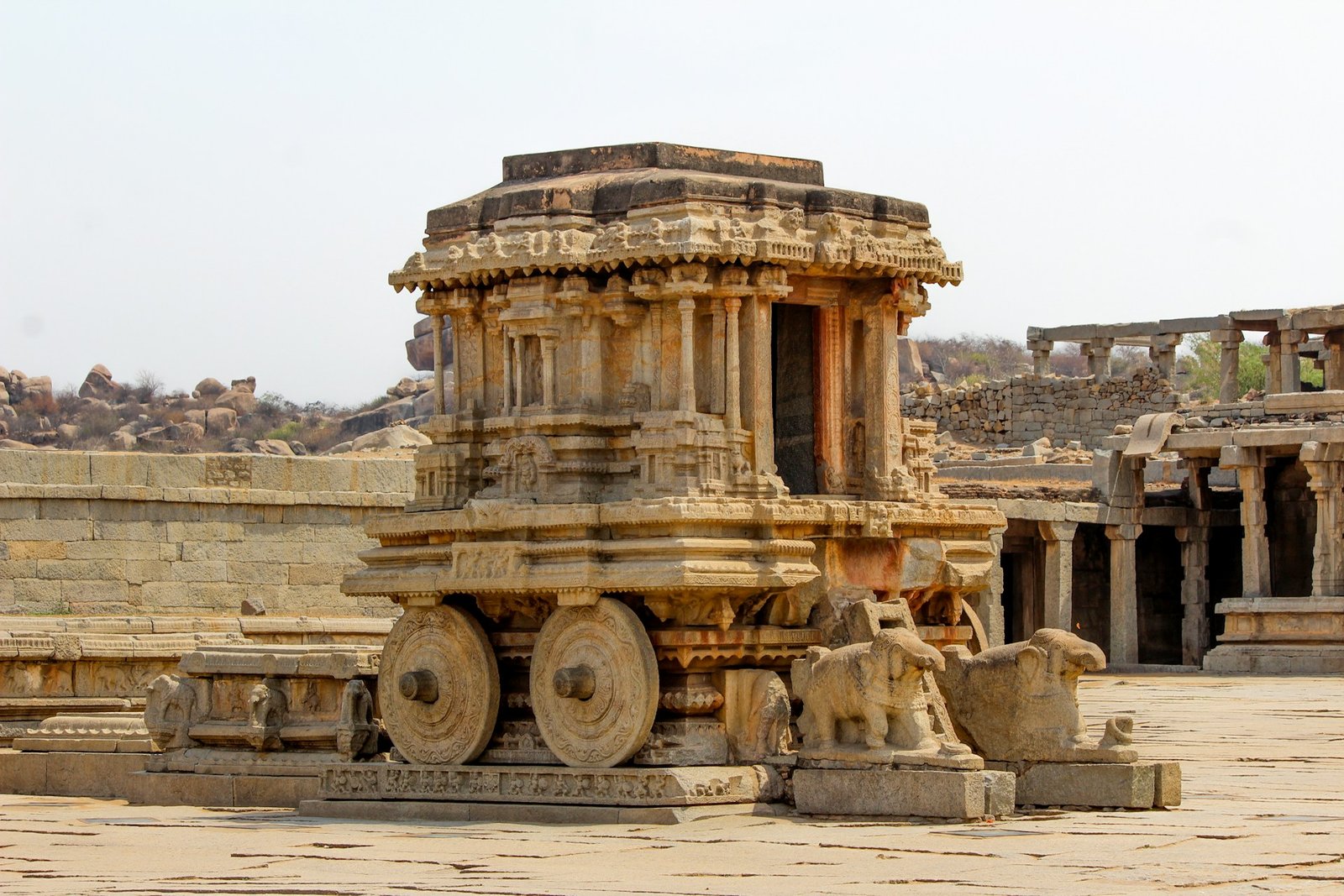
There is a stone chariot in Karnataka that was never meant to move. Carved entirely from a single granite outcrop in front of the Vittala Temple, it has stood in exactly the same spot since the 16th century, its wheels solid rock, its purpose purely symbolic. It is the single most photographed object in Hampi, and it is only the beginning of what the site actually contains.
Hampi was the capital of the Vijayanagara Empire, founded in 1336 by the brothers Harihara I and Bukka Raya I on the banks of the Tungabhadra River. At its height in the 16th century, Vijayanagara was among the largest cities in the world, a Persian ambassador visiting in 1442 wrote that his eyes had never seen a place like it. In 1565, a confederation of Deccan sultanates defeated the empire at the Battle of Talikota. The city was sacked and looted for six months, then abandoned. What survives is more than 1,600 structures spread across roughly 4,180 hectares, temples, royal enclosures, elephant stables, market streets, and water systems, scattered through a landscape of granite boulders that predates the empire by millions of years.
The boulders are not incidental. Vijayanagara’s architects built into the existing rock formations rather than clearing them, so temples emerge directly from hillsides and courtyards wind around house sized stones left exactly where geology put them. It gives Hampi a texture no other ruin in India has, part engineered city, part landscape that was already finished before anyone arrived.
The Virupaksha Temple, at the site’s centre, is the detail most visitors miss. Unlike everything around it, Virupaksha never stopped functioning. It has held continuous daily worship through the empire’s rise, its destruction, and the four centuries of silence since, making it one of the oldest continuously active temples in India and the one place in Hampi where the past isn’t past tense.
Hampi was inscribed as a UNESCO World Heritage Site in 1986. October to February is the only sensible window to visit, daytime temperatures hold in the twenties with cool evenings, while summer routinely crosses 40 degrees Celsius and the exposed granite gets hot enough to burn bare feet. Base in Hampi Bazaar for walking distance to the main temple complex, or across the river in Anegundi for a quieter, more rural stay. Either way, budget two full days. The site is large enough that most visitors underestimate it on arrival and run out of daylight before they run out of ruins.