
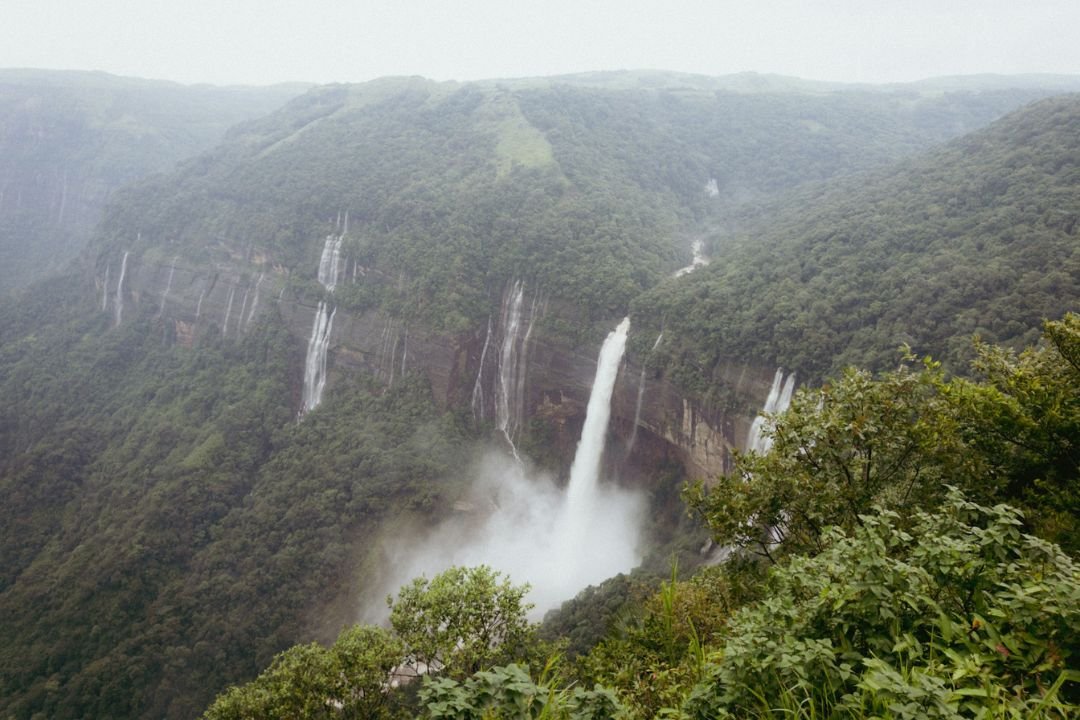
Cherrapunji holds the world record for the most rainfall in a single year. Mawsynram, twelve kilometres away, holds the record for the highest average annual rainfall. Between them, they receive more water from the sky than almost anywhere else on Earth.
You might wonder why anyone would visit during monsoon.
You would be wrong to wonder.
Meghalaya the name means abode of clouds in Sanskrit is at its most extraordinary precisely when it is wettest. The waterfalls are at full force. The living root bridges span gorges running with white water. The clouds move through the Khasi Hills like living things. And the landscape achieves a shade of green that exists nowhere else.
What Makes Meghalaya Different
Most Indian hill stations become shadows of themselves in monsoon the views disappear, the roads deteriorate, the experience diminishes. Meghalaya inverts this entirely.
The clouds are not obstacles here. They are the landscape. Watching them move through the East Khasi Hills from a viewpoint above Cherrapunji rising from the Bangladesh plains below, catching on the cliffs, breaking apart and reforming is one of the great natural spectacles in Asia.
What To Do
Nohkalikai Falls India’s tallest plunge waterfall drops 1,115 feet into a pool of extraordinary turquoise-green. In monsoon, the volume of water is so great that the mist from the falls reaches you before you see them. Stand at the viewpoint in the rain and feel the scale of it.
The Living Root Bridges of Nongriat The double-decker living root bridge grown over centuries from the aerial roots of rubber fig trees by the Khasi people is one of the genuine wonders of India. The 3,500-step descent to reach it is steep and slippery in monsoon. Bring good shoes and go anyway. The bridge itself, with the River Umshiang running fast below it and ferns growing from every surface, is worth every step.
Dawki and the Umngot River In the dry season, the Umngot River at Dawki is famous for its transparency boats appear to float on air. In monsoon, it runs deep and fast and an entirely different shade but the drive down to Dawki through the Jaintia Hills, with waterfalls appearing around every corner, is reason enough to go.
Mawlynnong Asia’s cleanest village. See Article 2 for the full picture but in the context of a Meghalaya trip, it belongs here as a half-day that reminds you what a community can achieve when it decides to take care of itself.
Where to Stay
Cherrapunji Holiday Resort the best-positioned property in the area, with views across the valley that, in monsoon, mean you are watching clouds form below your window.
Ri Kynjai, Shillong on the banks of Umiam Lake, one of the most beautifully designed properties in Northeast India. The lake in monsoon, surrounded by hills, is extraordinarily atmospheric.
Getting There
Fly to Shillong (via Guwahati) or drive from Guwahati approximately 100 km. The NH6 through the hills is in good condition and the drive is, in monsoon, one of the most beautiful in Northeast India.
A Practical Note
Monsoon in Meghalaya means rain serious, sustained, magnificent rain. Pack accordingly. Waterproof layers, good shoes, dry bags for electronics. And embrace it. The travellers who fight the weather here miss the entire point.