
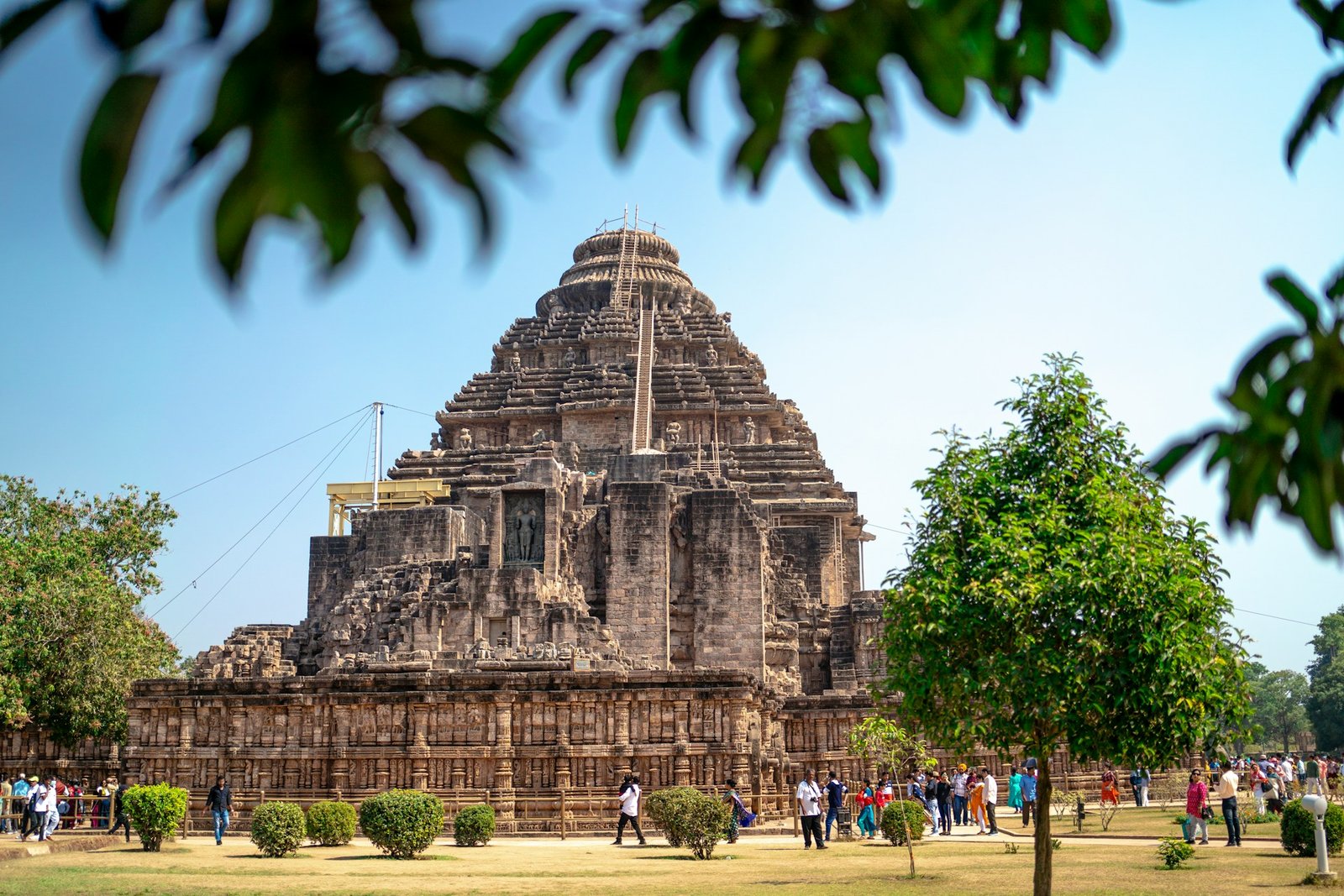
Odisha has a UNESCO World Heritage temple built as a giant stone chariot, a lagoon larger than Goa that holds one of the last populations of Irrawaddy dolphins in India, nearly 500 kilometres of coastline, a tiger reserve recognised by UNESCO, and a tribal population practising traditions found nowhere else on the subcontinent. Most Indian travellers could not name a single one of these without prompting. That is not a knock on the state. It is the actual reason to go.
Start with Konark. The Sun Temple, built around 1250 CE by King Narasimhadeva I of the Eastern Ganga dynasty, is designed as Surya’s chariot, 24 elaborately carved stone wheels and a team of horses, the whole structure oriented so the rising sun’s first light would once have struck the sanctum directly. The main tower collapsed centuries ago and only the assembly hall and chariot platform survive intact, but what’s left is still one of the most technically ambitious temple structures ever built in India, each wheel functioning as a working sundial with spokes that cast an accurate shadow of the time of day. UNESCO inscribed it as a World Heritage Site in 1984. Rabindranath Tagore called it the place where the language of stone surpasses the language of man, which is the kind of line that sounds like marketing until you’re standing in front of the wheels.
Thirty five kilometres south is Puri, home to the Jagannath Temple and one of the four holiest pilgrimage sites in Hinduism, and beyond it, Chilika Lake, Asia’s largest brackish water lagoon at just over 1,100 square kilometres. Chilika is a Ramsar wetland of international importance and the largest wintering ground for migratory birds anywhere on the Indian subcontinent, flamingos, pelicans, and thousands of other species arriving from as far as Siberia between November and February. The lake is also one of only a handful of places in India where Irrawaddy dolphins can reliably be seen, from Satapada on the eastern shore, a species so rare it exists in only a few locations across all of South and Southeast Asia.
Inland, the state holds Simlipal National Park, one of India’s designated tiger reserves and a UNESCO Biosphere Reserve, along with waterfalls, sal forests, and one of the country’s more overlooked wildlife circuits. The tribal belt in the state’s interior, home to communities including the Kondh, Santal, and Bonda, holds weekly haats, periodic markets that double as the region’s most authentic cultural window, along with distinct textile and metalwork traditions rarely sold outside the state.
The reason Odisha stays empty isn’t accessibility, Bhubaneswar has a functioning airport with direct flights from most major Indian cities. It’s that the state has never built a single marketing image the way Kerala built backwaters or Rajasthan built forts. What it has instead is breadth, a UNESCO temple, a UNESCO scale wetland, a tiger reserve, and a tribal heartland, all within a few hours’ drive of each other, and almost none of it requires fighting a crowd to see properly. October to February is the window, cool enough for the temples and the wildlife parks, and exactly when Chilika’s migratory birds are at their peak.