
Madhya Pradesh is the second largest state in India by area and it sits in the exact geographic centre of the country, which means almost every domestic traveller has passed over it or through it without stopping. It holds three UNESCO World Heritage sites, some of the best tiger reserves in Asia, a deserted medieval capital that most people have never heard of, and rock shelters with paintings that are among the oldest human art in the subcontinent.
It receives a fraction of the tourism of Rajasthan, which is roughly comparable in what it offers and considerably better at telling people about it.
Khajuraho, and the misunderstanding
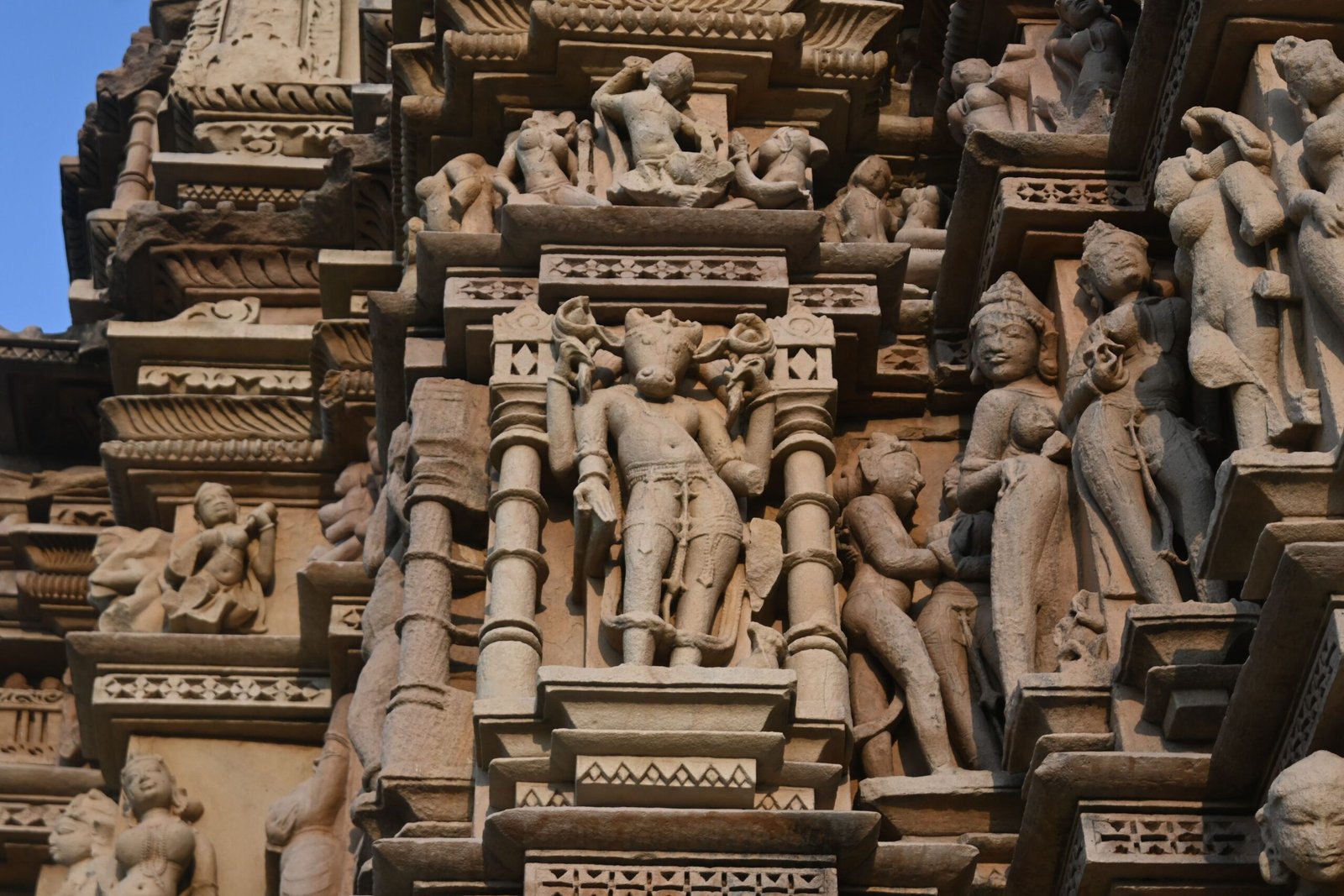
Khajuraho is famous for the wrong ten percent of itself. The erotic sculpture is real, it is remarkable, and it accounts for a small proportion of the carving on the temples. What is actually there is a group of stone temples built by the Chandela dynasty between roughly the tenth and twelfth centuries, of which about twenty survive of an original eighty five, covered in some of the most technically accomplished figurative sculpture produced anywhere in medieval India.
The Western Group holds the largest and best preserved, including the Kandariya Mahadeva, and it is where the ticketed crowds go. The Eastern and Southern Groups are a short ride away, are included in the same ticket, and are frequently empty. The Jain temples in the Eastern Group are as finely carved as anything in the west and have perhaps a tenth of the visitors.
Go early. The site opens at sunrise and the stone takes low light far better than midday. The sound and light show in the evening is optional. The temples at seven in the morning are not.
Orchha, which should be famous and is not
Ninety minutes from Jhansi, on the Betwa river, sits a sixteenth century Bundela capital that was abandoned and then largely left alone. Orchha has palaces, cenotaphs and temples in the quantity you would expect of a major Rajasthani town and roughly none of the crowd.
The Jehangir Mahal is the set piece, built to house the Mughal emperor for a visit that reportedly lasted a single night. The chhatris along the river, fourteen royal cenotaphs standing in a row, are the image people remember, particularly in the late afternoon from the far bank. And the Ram Raja Temple is the strange one: an ordinary looking palace that became a temple because an idol installed there temporarily refused, by tradition, to be moved. It is the only place in India where Rama is worshipped as a king, with an armed guard of honour.
Orchha is small enough to walk and quiet enough that the walking is the point. Two nights is right. One night is a mistake people regularly make.
The tigers
Madhya Pradesh consistently holds among the largest tiger populations of any Indian state, and the two reserves that matter most for a visitor are Bandhavgarh and Kanha.
Bandhavgarh is smaller and has historically had one of the highest tiger densities in the country, which translates into better odds on a short trip. Kanha is larger, more forested, has the sal woodland and grassland that inspired Kipling’s setting, and is the last refuge of the barasingha, the hard ground swamp deer brought back from near extinction there.
Practical points that matter more than the choice between them:
● The parks close for the monsoon, generally from 1 July to 30 September, with some zones reopening on different dates. Confirm before booking.
● October to March is the comfortable window. April to June is hot, uncomfortable, and considerably better for sightings, because the animals concentrate at water.
● Safari permits are booked online and the core zone permits for the good mornings go early. This is not a decision to leave to arrival.
● Book three or four safaris, not one. A single drive is a lottery ticket.
Bhimbetka, which is older than everything else here by an order of magnitude
About forty five kilometres from Bhopal, the Bhimbetka rock shelters hold paintings made across a span of many thousands of years, some of the earliest traces of human life on the subcontinent, in caves that were occupied more or less continuously. It is a UNESCO site, it takes half a day, and it is nearly always uncrowded.
Combine it with Sanchi, an hour on the other side of Bhopal, where the Great Stupa was begun under Ashoka in the third century BCE and the carved gateways are among the finest early Buddhist sculpture anywhere.
How to actually string it together
The state is large and the sites are not close together. Two workable circuits:
The monuments circuit, five to six days. Fly into Khajuraho, two nights. Drive to Orchha via Panna, two nights. Train out from Jhansi, which is on the main Delhi to Bhopal line and well connected.
The wildlife circuit, five to seven days. Fly into Jabalpur. Bandhavgarh and Kanha are both reachable from there, roughly four to five hours each by road, and the two can be combined with a long transfer between them. Add Pench if you have the time.
The ambitious version joins them. Khajuraho to Bandhavgarh is a long but manageable drive, and it makes for a nine or ten day trip that covers temples, a deserted capital and tigers without repeating a single kind of day.
The thing nobody says about MP
Distances are real. This is a state where a hundred and fifty kilometres can take four hours, and where the pleasure of the trip depends substantially on not scheduling six of those days back to back. Build in the nights. Orchha and the parks both reward staying still.