
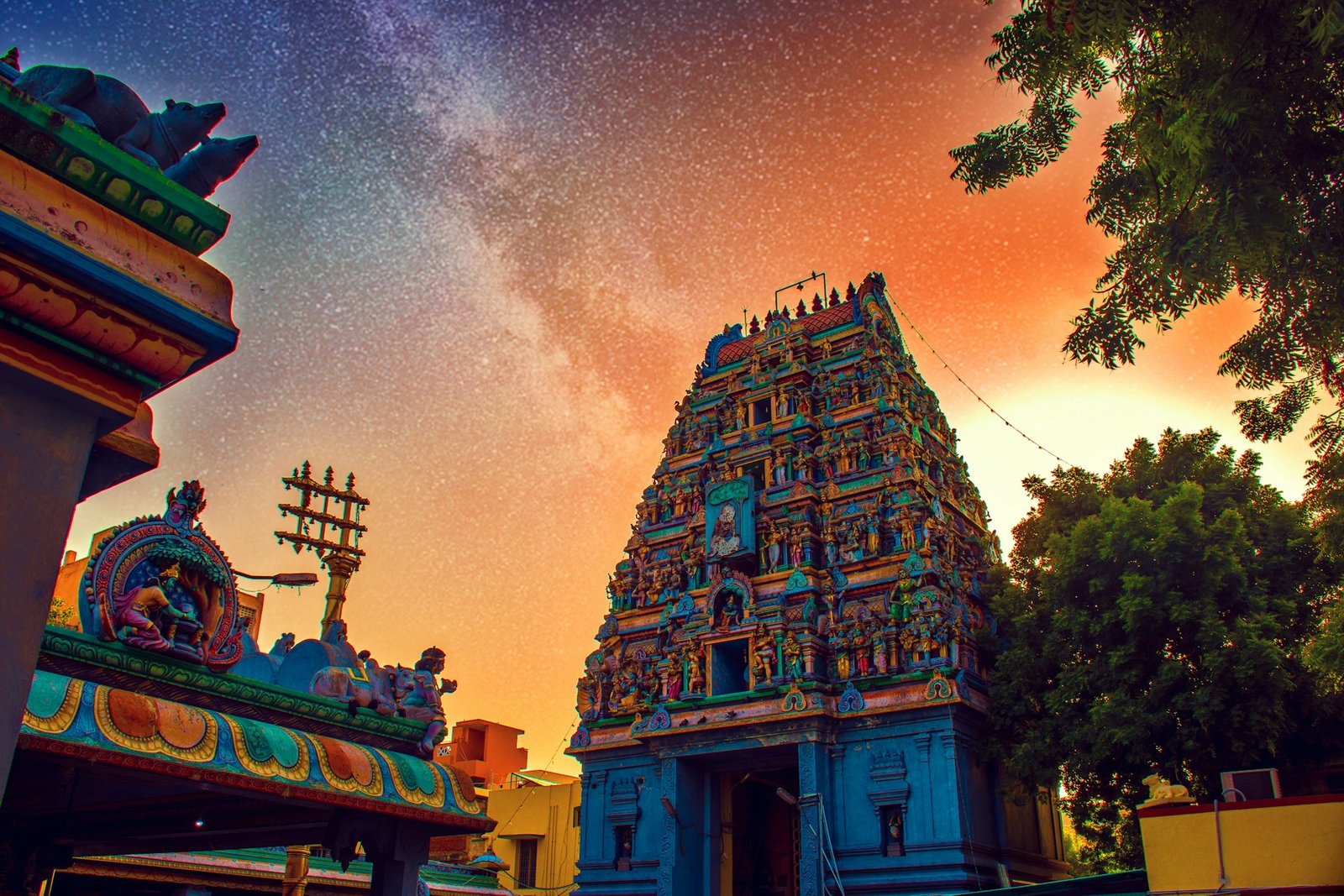
There is a stretch of Tamil Nadu where temples stopped being buildings and became towns. Not a shrine at the edge of a settlement, but a walled complex several hectares across with the streets, the markets and the daily life of the city arranged in concentric squares around it.
Four of them sit within a few hours of one another, and together they cover roughly two thousand years of continuous religious architecture. Most visitors to south India see none of them.
Madurai
The Meenakshi Amman Temple is the one everybody knows and it deserves the reputation. Fourteen gopurams rise above the old city, the tallest close to fifty metres, each one covered in thousands of painted stucco figures that are restored and repainted at the temple’s twelve yearly consecration.
Inside are the Golden Lotus tank, the Hall of a Thousand Pillars, which actually has closer to nine hundred and eighty five and each one carved differently, and a temple market that has traded in the corridors for centuries. Madurai itself claims to be the oldest continuously inhabited city in India and eats better than anywhere else on this route.
Thanjavur
The Brihadeeswarar Temple was completed in 1010 under Rajaraja Chola I, in roughly six or seven years, and it is the single most impressive piece of architecture in south India. The vimana above the sanctum rises about sixty six metres over thirteen tiers.
Two details are worth carrying with you. It is built entirely of granite, in a river delta whose nearest quarries were some sixty kilometres away, which meant moving something in the order of a hundred thousand tonnes of the hardest building stone there is. And it is assembled without mortar, the blocks interlocked and notched, which is how it has stood for a thousand years.
It is a UNESCO World Heritage Site and part of a group of three Chola temples, the others at Gangaikonda Cholapuram and Darasuram, both within a short drive and both nearly empty of visitors.
Chidambaram
The Nataraja Temple is where Shiva is worshipped as the cosmic dancer, and it is unusual in several ways. The sanctum holds an empty space rather than an image, representing the formless. The temple is administered not by the state but by a hereditary community of priests. And the gopurams carry the complete set of one hundred and eight karanas, the fundamental positions of Bharatanatyam, carved in sequence.
For anyone with an interest in Indian classical dance, this is the source document.
Rameswaram
At the far end of an island reached by the Pamban bridge, the Ramanathaswamy Temple is one of the twelve Jyotirlingas and one of the four Char Dham sites, which puts it among the most significant pilgrimage destinations in the country. Its corridors are among the longest of any temple in India.
Twenty kilometres further on lies Dhanushkodi, a town destroyed by a cyclone in 1964 and never rebuilt, where the Bay of Bengal meets the Indian Ocean and Sri Lanka sits about twenty four kilometres across the water.
What nobody tells you
Almost all of these temples close for several hours in the middle of the day, typically from around half past twelve until four. Planning a temple for the early afternoon is the most common way to waste a day here.
Dress codes are real and they are enforced at the gate, most strictly at Rameswaram, where jeans are not permitted for anyone. Men are generally expected in a dhoti or traditional trousers and women in a saree or a set mundu. Dhotis can usually be hired at the entrance.
Rameswaram enforces one more thing worth knowing. If you intend to do the twenty two theertham ritual, in which temple staff pour water from twenty two wells over you, you will need two sets of clothing, because you cannot enter the sanctum wet. Visitors who arrive with one set have to choose between the ritual and the darshan.
Some temples restrict inner sanctum entry to Hindus. Phones and cameras are usually barred inside and lockers are available at the gates.
November to February is the sensible window. Madurai and Trichy are the two airports that make the circuit work.