
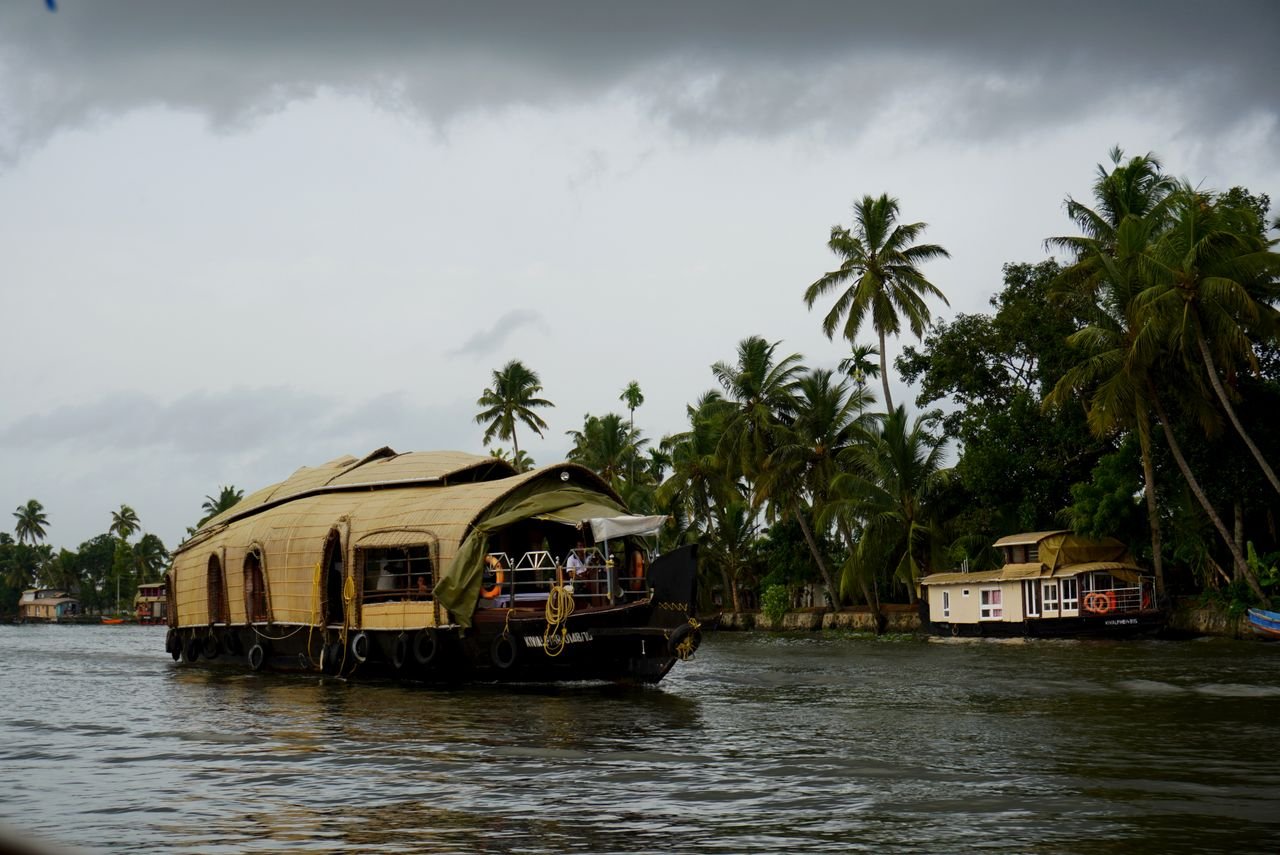
Kerala has a peak season and it runs from December to February, when the weather is dry, the rates are highest and the backwaters are busy. It is a perfectly good time to visit. It is also not the time Kerala looks its best.
The southwest monsoon finishes with the state at its most saturated. Rivers full, paddy fields flooded, the hills a green so intense it reads almost artificial in photographs. September and early October catch Kerala in exactly this state, after the heaviest rain has passed but before the landscape starts drying out. Room rates are still low. The crowds have not arrived.
The backwaters, properly full
Alleppey and Kumarakom in December are pleasant. Alleppey in September is something else, with canals brimming, the paddy fields on either side under water, and far fewer houseboats sharing the same channels.
Consider a smaller boat. The large multi deck houseboats cannot enter the narrow canals where villages actually sit, so a shikara or a canoe for a few hours will show you more of the backwaters than a full day on a big boat will.
Munnar at its greenest
Munnar is tea country, and tea country after monsoon is a different colour altogether. The estates run up and over the hills in every direction, mist sits in the valleys through most of the morning, and the roads are largely empty of the December convoys.
Rain has not finished entirely, and that is part of the point. Kerala receives a second, lighter monsoon from the northeast between October and December, and an afternoon shower in the hills is normal rather than a disruption.
Onam
Kerala’s biggest festival follows the Malayalam calendar and falls in August or September depending on the year. If your dates line up, it changes what a trip here feels like. Flower carpets outside houses, snake boat races on the rivers, and the sadya, a vegetarian feast of twenty or more preparations served on a banana leaf and eaten in a specific order.
Book accommodation well ahead if you are travelling during Onam week. Kerala is a state that comes home for this one.
Where else to look
Athirappilly is at full force after monsoon and worth the detour from Kochi. Wayanad, further north, gets a fraction of Munnar’s visitors and has the better forests. Thekkady and the Periyar reserve are good for spotting wildlife around water sources. And Fort Kochi is worth two unhurried days rather than the half day most itineraries give it.
What nobody tells you Some hill roads and trekking routes stay closed until the ground firms up, so check locally rather than assuming. Leeches are a genuine feature of post monsoon forest walks, and salt or a good pair of leech socks solves the problem entirely. And book houseboats directly with operators where you can; the commission layered onto third party bookings in Kerala is among the highest anywhere in India.