
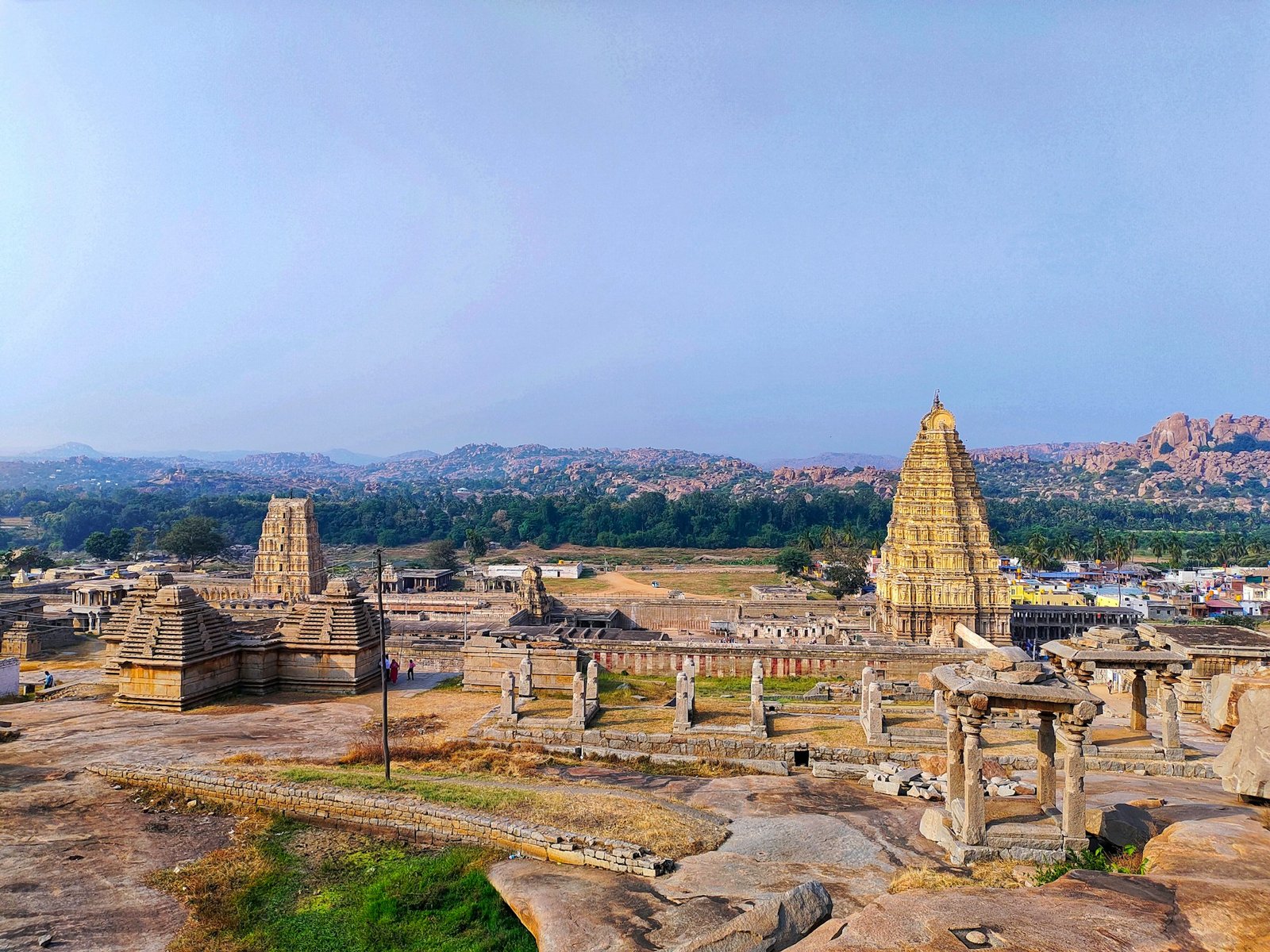
In the year 1500, a city on the banks of the Tungabhadra river in what is now Karnataka was, by most estimates, the second largest city on earth, smaller only than Beijing. Its markets traded in diamonds, pearls, Persian horses, and fine silk. Portuguese and Persian travellers who visited wrote home in a kind of disbelief, describing a capital so wealthy and so vast that European cities of the time seemed provincial by comparison. That city was Vijayanagara. What remains of it today is called Hampi, and it is, without much competition, the most extraordinary ruin in India that most Indians have still not visited.
A kingdom that ruled for two centuries and vanished in six months
Hampi predates the empire that made it famous, mentioned in the Ramayana and the Puranas under the name Pampa Devi Tirtha Kshetra, and settled since at least the third century BCE. But it was the Vijayanagara Empire, founded in 1336 by two brothers, Harihara and Bukka, that turned it into one of the great capitals of the medieval world. For over two hundred years, a dynasty of Hindu kings ruled from here, reaching its absolute peak under Krishna Deva Raya between 1509 and 1530, a ruler remembered for both military dominance and an extraordinary patronage of art, temple building, and literature.
Then, in 1565, a coalition of Deccan Sultanates defeated the Vijayanagara army at the Battle of Talikota. What followed was not a quick conquest but a methodical, six month long sacking of the city, palaces stripped, temples defaced, markets burned. Hampi was abandoned soon after and never rebuilt. What survives is essentially a snapshot of a civilisation interrupted mid sentence, which is precisely why UNESCO declared it a World Heritage Site in 1986 and why walking through it today feels less like visiting a museum and more like trespassing on someone else’s unfinished century.
More than sixteen hundred reasons to slow down
The scale of what remains is difficult to process from photographs alone. Over 1,600 surviving monuments spread across more than 4,100 hectares of boulder strewn landscape, split loosely into a sacred centre of temples and a royal centre of palaces, baths, and administrative structures. Locals and UNESCO both describe it, without much exaggeration, as the world’s largest open air museum.
The Vittala Temple complex is the one every visitor eventually photographs, home to the stone chariot that has become Hampi’s unofficial emblem, and to a set of musical pillars that are said to produce different tones when struck, a detail so intriguing that the British, on encountering it during the colonial period, reportedly cut into a few of them trying to understand how. The temple’s great chariot street once hosted festival processions that drew traders and pilgrims from across the empire.
Virupaksha Temple, older than the empire that surrounded it, remains an active place of worship even now, one of the few structures in Hampi where the past and the present have never actually stopped talking to each other. Its temple elephant, a much loved resident, still blesses visitors with her trunk in exchange for a small offering, one of the most photographed small rituals in the entire complex.
The Lotus Mahal and the Elephant Stables, both in the royal centre, show something else entirely, a deliberate blending of Hindu and Indo Islamic architectural styles, evidence of a court that was cosmopolitan enough to borrow freely from the world it traded with.
Getting the timing right
Hampi is technically visitable year round, but March through June brings genuinely punishing heat, regularly touching 35 to 42 degrees, uncomfortable for a site that demands hours of walking across exposed granite and open ground. October through February is the accepted best window, daytime temperatures a much more forgiving 22 to 30 degrees. The monsoon months of July through September bring their own reward, a green flush across the boulder landscape that photographs beautifully, with less rainfall than most of India’s monsoon belt experiences.
Entry to the main monuments runs 40 rupees for Indian citizens, with the Vittala Temple charging an additional 30 rupees. Children under 15 enter free. It is, for what it offers, one of the least expensive extraordinary experiences left in the country.
How to actually spend the day
A single day is not enough, though many visitors attempt it. A more honest itinerary spreads across two days, one for the sacred centre and river side monuments, the Virupaksha Temple, the Vittala complex, Hemakuta Hill for sunset, and a second for the royal centre, the Archaeological Museum at Kamalapura for context before wandering, followed by the Queen’s Bath, Lotus Mahal, Elephant Stables, and the Mahanavami platform.
Cross the Tungabhadra by coracle, the round woven boats that have ferried people across this river for centuries, and reach Anegundi village on the far bank, older even than Hampi itself and considerably quieter. Climb Anjaneya Hill as evening sets in, believed by many to be the birthplace of Hanuman, for a sunset view back across the boulder strewn valley that puts the entire scale of the ruined city into a single frame.
Getting there
Hospet, thirteen kilometres away, is the nearest railway junction and the most practical base for onward travel by auto or taxi. Hubli airport, roughly 170 kilometres out, is the nearest by air, with Bengaluru a further, more comfortable option for those willing to add a few hours of road travel to reach one of India’s genuinely essential historical sites. Hampi does not need embellishment. It needs only the patience to walk slowly through what remains of a city that briefly, four hundred years ago, was one of the richest and most cosmopolitan places on the entire planet.