
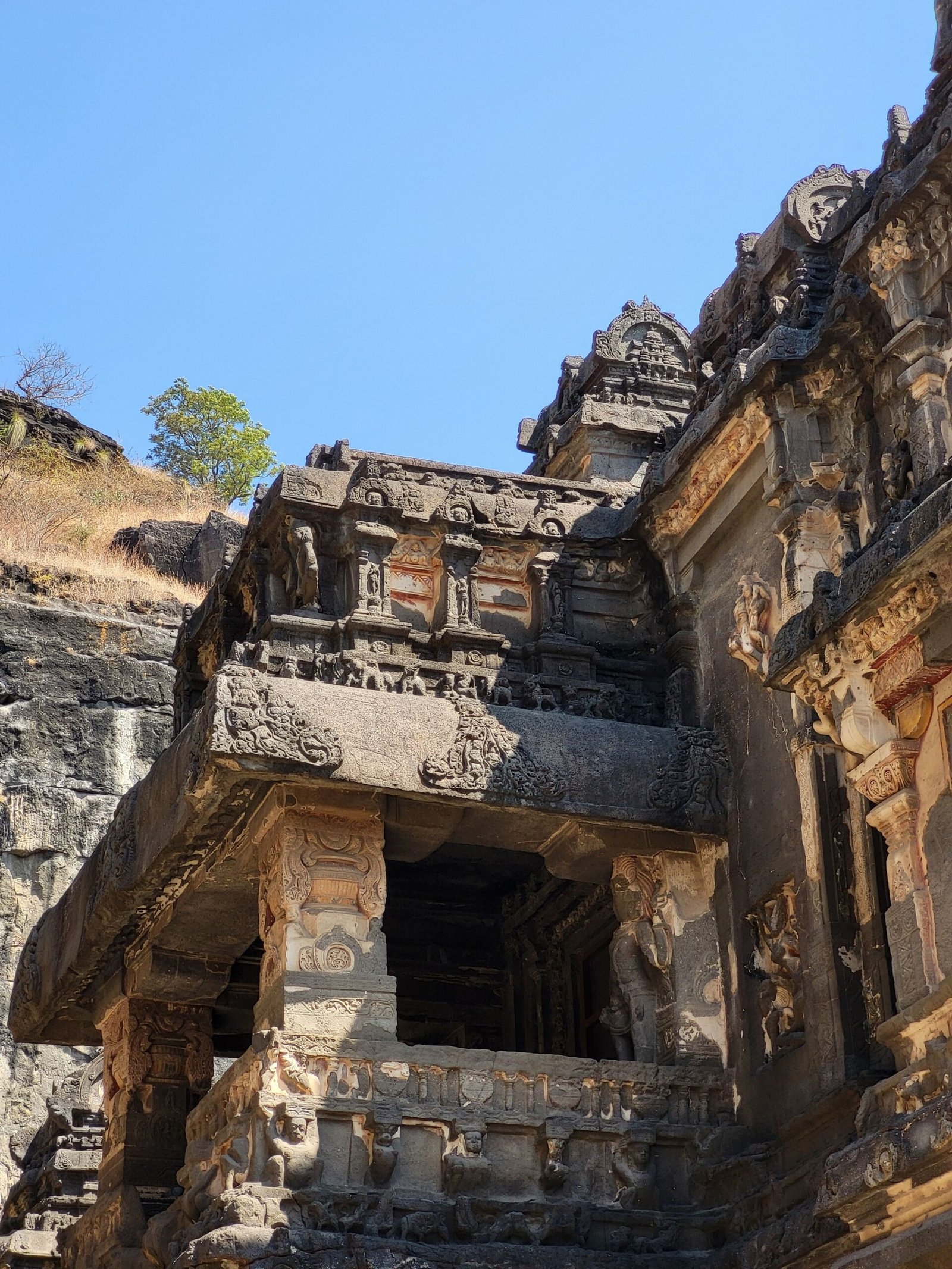
There is a temple in Maharashtra that was not built. It was excavated, carved downward and inward out of a single basalt hillside, roof first, with something on the order of two hundred thousand tonnes of rock removed and nothing added. No blocks were laid. No joints exist. The Kailasa temple at Ellora is the largest monolithic structure of its kind anywhere in the world, and it was made in the eighth century by people working from the top down, with no ability to correct a mistake.
It is roughly thirty kilometres from a city most travellers have never had a reason to visit, and about a hundred kilometres from a set of painted caves that are, by a considerable margin, the most important surviving body of ancient painting in India.
Both are UNESCO World Heritage sites. Both can be done from the same base. Most itineraries of India do not include either.
Ajanta: the paintings
Ajanta is a horseshoe shaped gorge above the Waghora river holding about thirty rock cut Buddhist caves, excavated in two distinct phases separated by several centuries. The earlier group dates from around the second century BCE, the later and more elaborate group from the fifth century CE under Vakataka patronage.
Then they were abandoned, and the jungle closed over them, and they sat essentially undisturbed until a British hunting party stumbled on the site in 1819.
That abandonment is why the paintings survive. Almost nothing else of ancient Indian mural painting does. What is on those walls, the Bodhisattva figures of Cave 1, the narrative Jataka cycles running across whole chambers, the crowded courts and processions, is the closest thing we have to seeing how India looked to itself in the fifth century.
How to see them properly:
● The caves are dimly lit by design, because light damages pigment. Your eyes need several minutes to adjust in each cave. Rushing through in ninety minutes means seeing almost nothing.
● Flash photography is prohibited and the prohibition is enforced. This is not a place for a phone camera to produce anything worth keeping. Look instead.
● Caves 1, 2, 16, 17 and 19 hold the best of the painting and sculpture. If time is short, those five slowly beat all thirty quickly.
● The site is closed on Mondays.
● Visitors park at a visitor centre several kilometres out and transfer by shuttle bus. Budget for this in the timing.
Ellora: the sculpture
Ellora is a different proposition. Thirty four caves cut into a basalt escarpment across roughly five centuries, and this is the part that makes it remarkable beyond the art: Buddhist, Hindu and Jain monuments sit side by side along the same cliff, built across a period when all three traditions were being patronised in the same region.
Kailasa, Cave 16, is the reason to come. It is a full Shiva temple complex with shrine, gateway, courtyard, freestanding pillars and life sized elephants, and the extraordinary fact attached that all of it is one piece of rock with the negative space removed. Walk up the path on the north side of the complex to look down into it. The view from above is the only one that makes the scale legible.
The Jain caves at the northern end, particularly Cave 32, are the ones most visitors skip because they involve a further walk or a short drive. They contain some of the finest carving on the site and are frequently near empty.
Ellora is closed on Tuesdays. Between them, the two closure days mean a badly planned two day trip can lose a site entirely. Check both before booking.
The base, and the rest of it
Both sites are visited from Chhatrapati Sambhajinagar, the city formerly called Aurangabad. It has an airport with connections to Delhi, Mumbai and Hyderabad, and it is on the rail network.
The city itself is usually treated as a bed and dismissed, which is unfair to two things in it. Bibi ka Maqbara, built by Aurangzeb’s son, is a scaled down Taj Mahal in the same basic form and a genuinely interesting object in its own right. And the Daulatabad fort, on the road to Ellora, is a fourteenth century hill fortress with a defensive design that is among the most inventive military architecture in India, including a spiral tunnel through the rock intended to be defended in the dark. It involves a substantial climb. Do it early in the day.
The two day plan that works
Day 1, Ellora. It is closer, about thirty kilometres out. Combine it with Daulatabad on the way, arriving at Ellora by mid morning. Half a day is enough if you are efficient. A full day is better.
Day 2, Ajanta. It is roughly a hundred kilometres from the city and the shuttle transfer adds time at the far end. Leave early. Do not attempt to fit anything else into this day.
Three days is more comfortable, with Bibi ka Maqbara and the city’s own caves filling the third. Reversing the order and doing Ajanta first also works, and has one advantage: seeing the paintings before the sculpture means arriving at Kailasa with nothing to compete against it.
What it costs you
The reason this pair is under visited is not quality. It is that Maharashtra does not have an established tourist circuit that includes them, so no standard itinerary sweeps them up the way Rajasthan’s does with its forts. Getting here is a deliberate decision.
It is a fairly small ask, two flights and two days from most Indian cities, for the two most significant rock cut sites on earth.