
Rajasthan has a problem that comes from being very good at what it does. Jaipur, Udaipur and Jaisalmer are extraordinary and they are also, in season, extremely full. The forts have ticket queues, the lake palaces have waiting lists, and the photograph you came for has forty people in it.
Two parts of the state escaped this almost entirely, and neither did so by being less interesting.
Bundi
Bundi sits in a narrow valley in the Hadoti region, about four hours from Jaipur and rather less from Kota. Rudyard Kipling stayed at the Sukh Mahal here in 1892 and is generally said to have drawn on Bundi for Kim, which he published nine years later. Whether he wrote any of it in the room they now show you is less certain than the signboard suggests, but the town he saw is largely the town that stands today.
Taragarh Fort rises above it, mostly unrestored and partly overgrown, which is precisely its appeal. The Bundi Palace below holds the Chitrashala, a gallery of murals in a distinctive blue green palette that ranks among the finest wall painting in India and which you will very likely have to yourself.
The town is also full of baoris, the stepwells that once supplied its water. Raniji ki Baori, built in 1699, is the grandest, descending several storeys underground in carved stone tiers. There are said to be dozens more scattered through the lanes, many of them unmarked.
Shekhawati
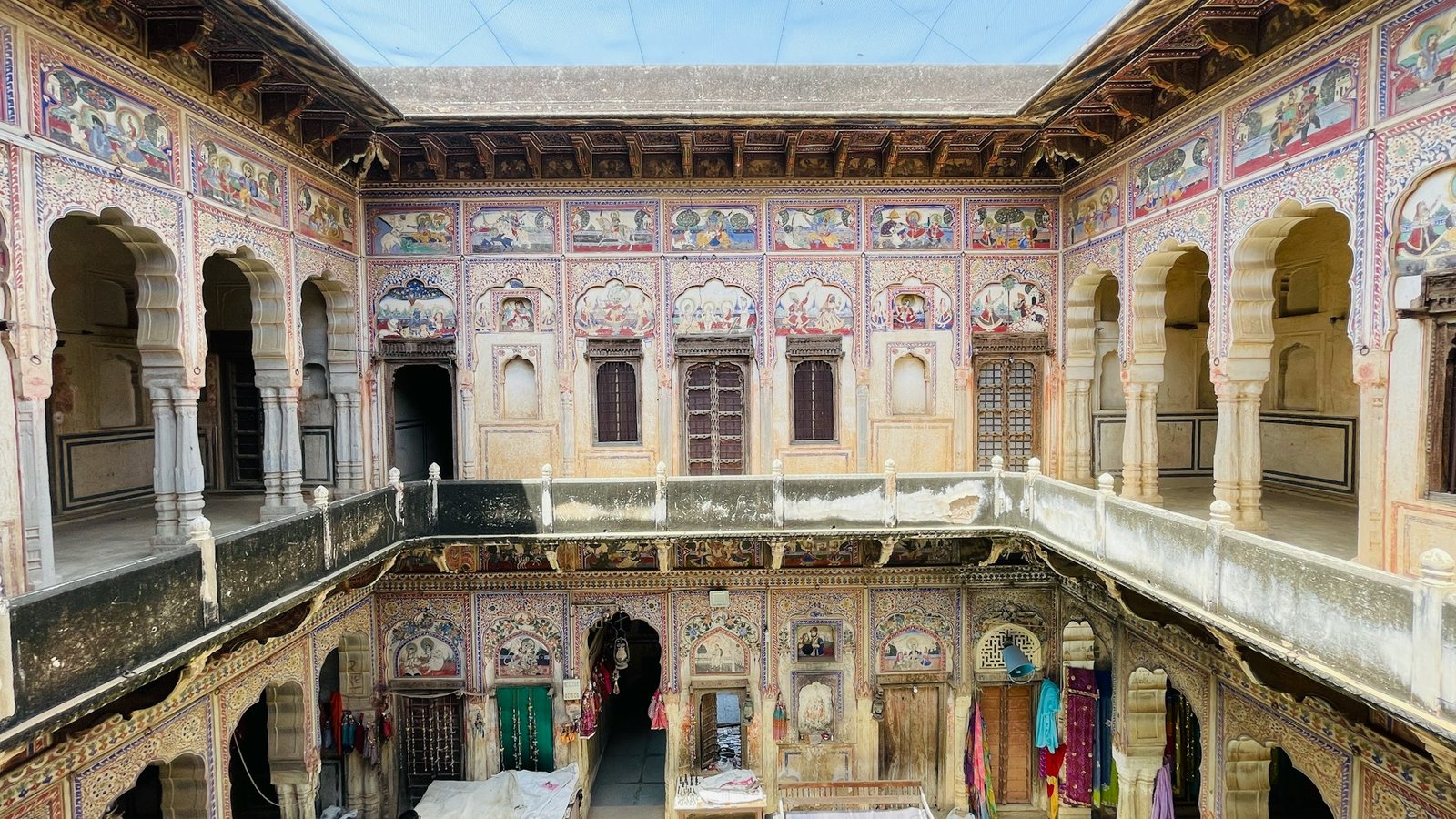
North of Jaipur, in a dry belt of small towns, sits what is sometimes called the largest open air art gallery in the world. In the eighteenth and nineteenth centuries the Marwari merchant families who dominated Indian trade built enormous havelis here and covered every available surface, inside and out, with painted frescoes.
The subjects drift wonderfully. Mythology and processions, and then, as the railways and the British arrived, trains, motor cars, gramophones, aeroplanes and Europeans in hats, painted by artists who had mostly never seen any of them.
Nawalgarh, Mandawa, Fatehpur and Ramgarh are the main towns. Many havelis are abandoned and quietly decaying, some are restored as hotels, and a few are museums.
Why they stayed quiet
Neither place is hard to reach and neither is undiscovered. What they lack is the single overwhelming monument that organises a tour bus itinerary. There is no Amber Fort here, no Lake Palace. What there is instead is a town you walk through slowly, and that does not fit into a coach schedule.
What nobody tells you
Bundi and Shekhawati sit in different directions from Jaipur and do not combine easily into a single loop. Bundi pairs naturally with Kota, Chittorgarh and Bhainsrorgarh. Shekhawati pairs with Bikaner or a return to Jaipur.
Many Shekhawati havelis are privately owned and occupied. A caretaker will often let you in for a small tip, which is the normal arrangement, but ask rather than walk in.
Bundi’s baoris are open and unfenced and some are deep. This is worth remembering if you are travelling with children.
October to March is the season. Accommodation in both places runs to restored havelis and small heritage hotels, and rates are a fraction of Jaipur or Udaipur for the same period.